


How dual-frequency 50Hz vs. 60Hz operation impacts AC axial cooling fan performance
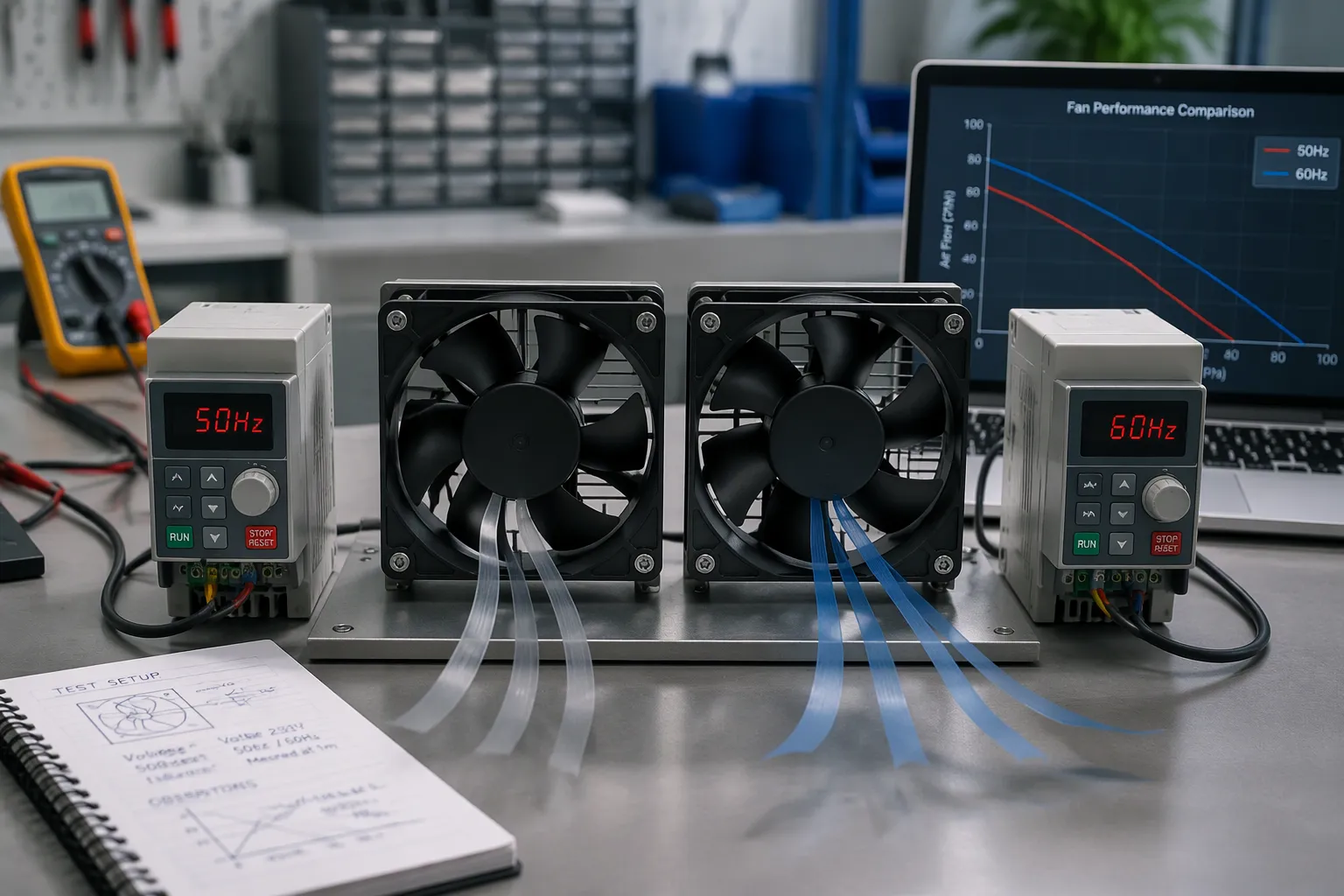
An ac axial cooling fan spins about 16–20% faster at 60hz than at 50hz. The higher speed raises airflow and static pressure, but it also raises power draw and noise. A 50hz supply gives lower airflow, less noise, and longer motor life.
Exporters have to deal with the 50hz vs 60hz gap. A fan sent to Europe runs at 50hz; the same unit in the Americas sees 60hz. Speed, airflow, input power, voltage, and motor temperature rise all change at 60hz. Overseas customers then face overheating alarms or overload trips.
Heavy machinery exporters, industrial OEMs, and electrical trading companies carry this risk. Belmont supplies axial fans for 50hz and 60hz grids, plus dual 50/60hz operation. Belmont publishes performance at each frequency, so dual frequency operation stays predictable.
Key Takeaways
A 60Hz power supply makes an AC axial fan spin 16–20% faster than a 50Hz supply does.
At 60Hz, the higher speed pushes more air and raises static pressure. But it also uses more power and makes more noise.
A 50Hz motor may get too hot when it runs on 60Hz. So check the current and the temperature rise before you ship it.
Fans that list both 50Hz and 60Hz curves cut export risk and make inventory simpler.
Pick the fan that fits the power grid where it will be used. Then check the thermal margin at the lower speed to make sure it runs reliably.
How frequency drives ac axial cooling fan performance
Frequency and motor speed
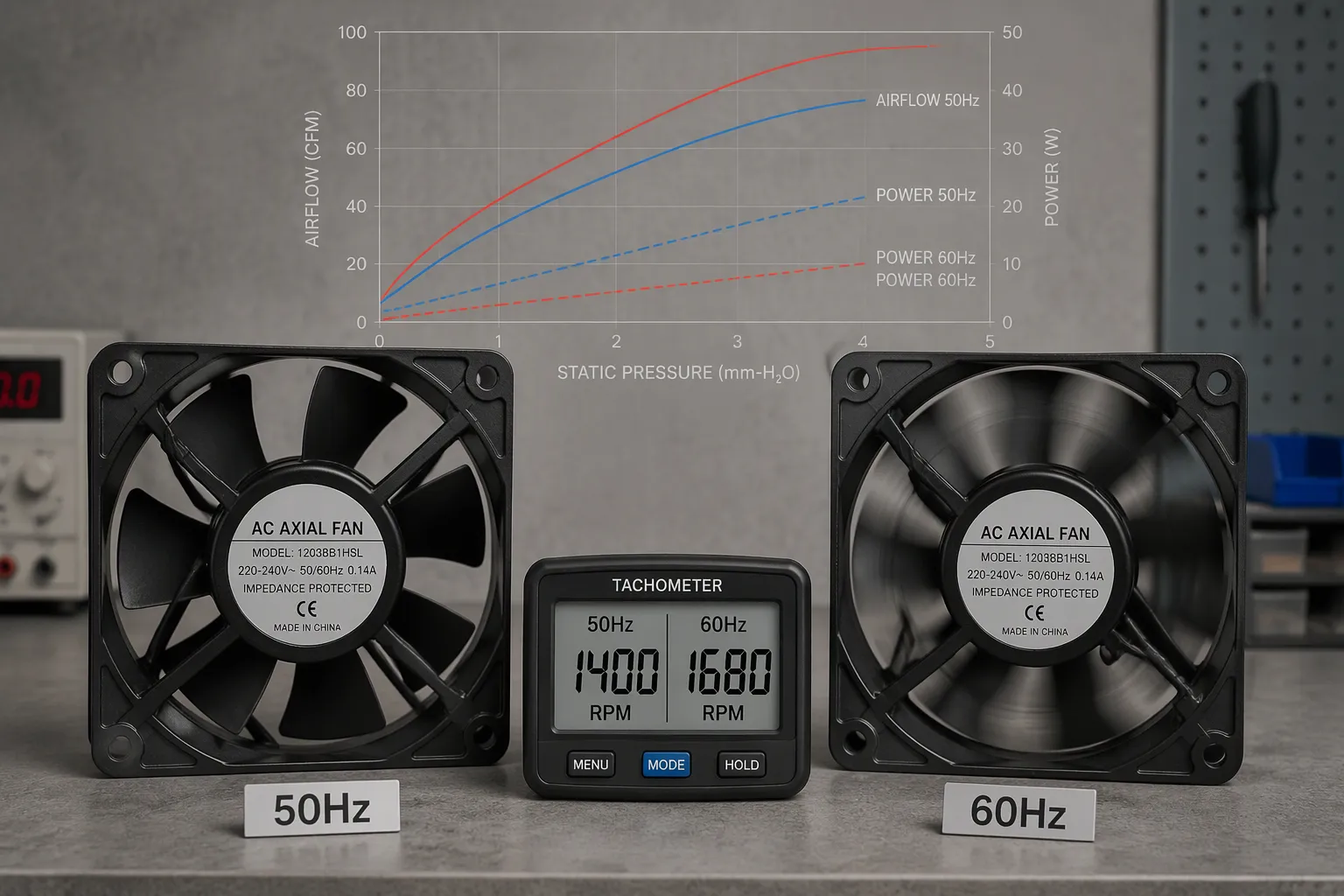
An ac axial cooling fan spins at a speed set by the power supply. The grid frequency and the number of motor poles set the synchronous speed. So a 50hz grid and a 60hz grid drive the same winding at different rates. The motor follows the grid, and the impeller follows the motor.
This link matters for export programs. A fan specified in Europe runs on 50hz. The same model shipped to North America or South America sees 60hz. The motor speed changed before the fan ever left the warehouse. Buyers who compare catalog sheets from different regions often compare two different operating points without knowing it.
Voltage plays a smaller role here. A motor designed for a given voltage band holds its speed close to the synchronous value across normal supply changes. Frequency sets the baseline. Voltage affects current and torque margin. Exporters should treat frequency as the main variable and voltage as the second one.
Belmont Axial Fan models come in 50hz, 60hz, and 50/60hz setups across 200–910mm sizes. Each setup carries its own performance data, so a buyer can match the fan to the destination grid instead of guessing.
The 16–20% speed gap
The 60hz speed of a given fan sits roughly 16–20% above its 50hz speed. The ratio of 60 to 50 is 1.2, and real motors land inside that band once slip and load are counted. A fan turning at 1,400 rpm on 50hz reaches about 1,680 rpm on 60hz. The gap is fixed by physics, not by brand or model.
That gap grows through the fan laws. Airflow rises in direct proportion to speed. Static pressure rises with the square of speed. Shaft power rises with the cube of speed. A 20% speed increase therefore pushes airflow up by about a fifth and power draw up by well over half. The exact figures depend on the operating point on the fan curve.
For an overseas end customer, the real result is a fan that moves more air and pulls more current than the European datasheet promised. Undersized wiring, a weak starter, or a tight thermal design can then trigger overload trips or overheating alarms. The fan itself may be healthy. The system around it was sized for the other frequency.
Specifiers should read the 50hz and 60hz columns as two separate products. Belmont publishes both, which lets an exporter confirm the 60hz current and the 50hz airflow before the shipment leaves. That step removes most of the surprise at the overseas site.
50hz vs 60hz: airflow and static pressure
Airflow change and cooling margin
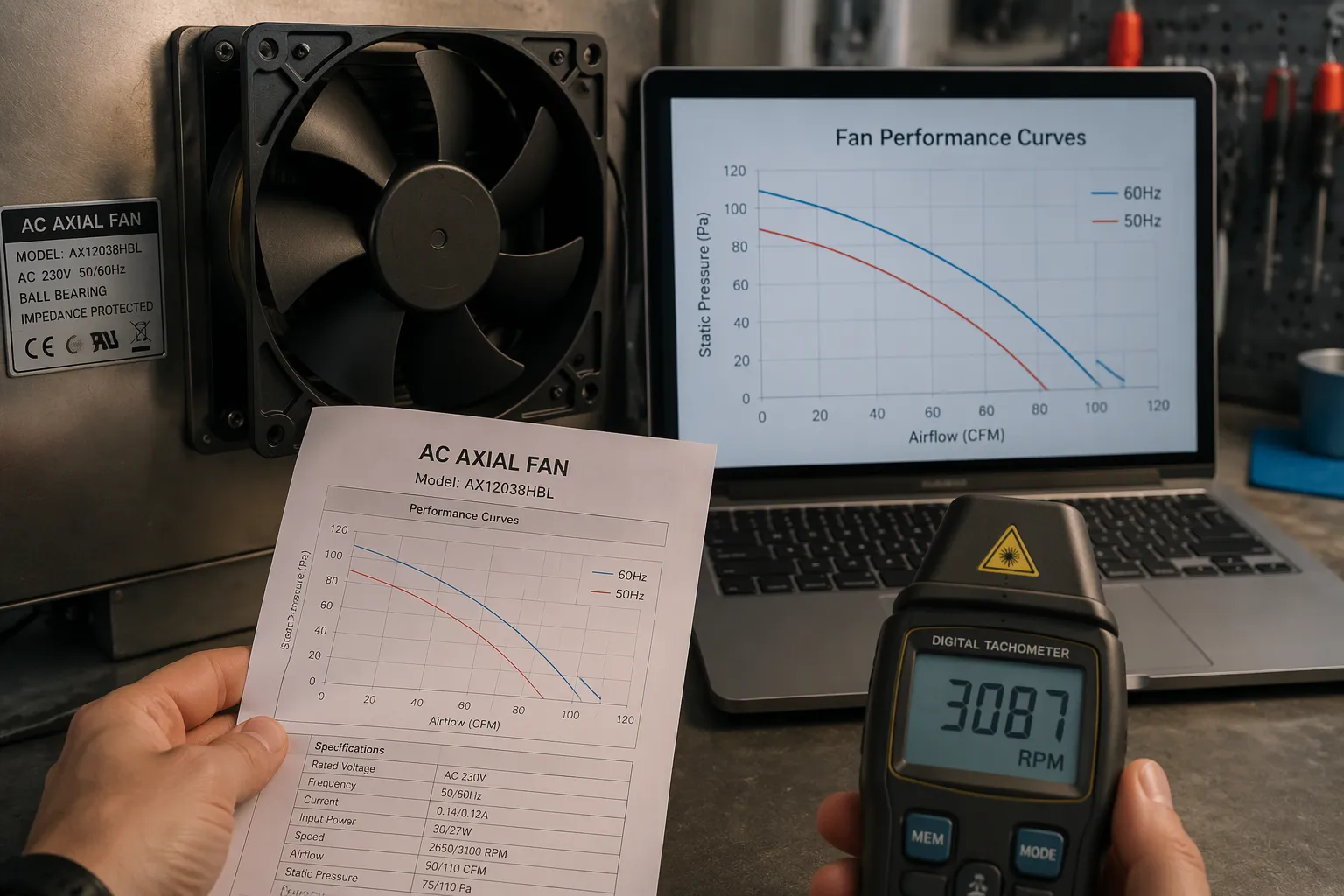
The fan curve shows what happens when the supply frequency changes. At 60hz, the motor spins faster, so the operating point moves up and to the right. The fan then gives more airflow and more static pressure at the same system resistance. At 50hz, the motor spins slower, so the operating point moves down and to the left. The fan gives less of both.
The fan laws explain how big the shift is. Airflow goes up in direct proportion to speed. Static pressure goes up with the square of speed. So a 20% speed increase lifts airflow by about a fifth and static pressure by roughly 44%. These relations come from the established fan laws, and they hold for any ac axial cooling fan within its normal range.
Cooling margin is where this shift turns into a design decision. A system sized at the 60hz operating point loses airflow when it runs on 50hz. The loss may be small, but a tight thermal design has no room for it. The safe approach is to pick a dual-frequency fan with margin for the lower-frequency case. The 60hz point then runs with headroom to spare.
Neither frequency is better by itself. The 50hz point suits systems with generous thermal margin and strict noise limits. The 60hz point suits systems that need maximum airflow from a given frame size. Belmont's dual-frequency AC axial fans ship with published 50/60hz performance curves and built-in cooling margin. Exporters can check both operating points before the shipment leaves, which takes the guesswork out of the overseas site.
How the fan curve shifts
The shift follows a predictable path along the curve. At 60hz, the whole curve moves upward and outward. The free-delivery airflow point rises, and the shut-off pressure point rises even more. The gap between the two curves gets wider as system resistance increases. So a ducted or filtered installation sees a larger pressure difference than an open installation.
This matters for export programs. A European customer specifies a fan against a 50hz curve. The same unit installed in North America runs on 60hz and sits on a different curve. The system resistance did not change, but the delivered airflow and static pressure did. Belmont publishes both curves for its dual-frequency models, so buyers can compare the two operating points side by side.
The practical rule is simple. Size the fan on the curve that matches the destination grid. Where one model must serve both grids, size it on the 50hz curve and confirm the 60hz current and motor temperature rise stay within limits. That method protects the cooling margin at the lower speed and keeps the higher speed inside the motor's thermal envelope.
Power draw and motor heating
Current and input power at each frequency
A motor that spins faster at 60hz uses more input power and current. Shaft power goes up with the cube of speed, so a 20% speed increase raises power draw by well over half. Current goes up too. A fan that pulls a modest current on 50hz can draw noticeably more on 60hz at the same load point.
This is where a 50hz motor on 60hz becomes a risk. The winding sees more current and more heat, and the motor may overheat without derating or design changes. A 60hz motor is usually fine at 50hz, but the reverse needs care. Belmont documents both operating points for its dual-frequency models, so exporters can check the 60hz current before shipment.
Winding stress and insulation class
The volts-per-hertz ratio explains much of the stress. A motor keeps a healthy magnetic flux when voltage and frequency rise together. A 50hz motor will run correctly on 60hz only when the design accounts for the higher speed and the added thermal load. A variable frequency drive changes this picture, because it controls both voltage and frequency together.
Insulation class sets the headroom. F-class insulation handles higher winding temperatures than lower classes, so a fan with F-class windings absorbs more of the 60hz penalty. Belmont builds its ac axial cooling fan range with F-class insulation and thermal designs that support stable operation across 50hz and 60hz grids. A v/hz ratio analysis at the selection stage shows whether a given model holds its margin on both grids.
Noise and vibration at higher motor speed
Aerodynamic noise at 60Hz
A faster impeller moves more air, and more air means more sound. At 60hz the blades pass the fan frame more often each second, so the tonal noise goes up and the broadband whoosh gets louder. The 16–20% speed gap between 50hz and 60hz is enough to hear in a quiet room. A fan that runs fine in a European plant may cause complaints once it runs on a 60hz grid in North America or South America.
The same higher speed also helps cool the motor. More air moves across the motor body, so the winding gives off heat faster. This airflow partly makes up for the extra heat from the higher current. The net effect depends on the fan design and the mounting position. A well-designed dual-frequency fan keeps the 60hz winding temperature within its insulation class, even with the added load.
The trade-off stays simple. A 50hz supply gives quieter operation. A 60hz supply moves more air. Belmont publishes noise data for both grids, so exporters can compare the two operating points before they quote a project.
Bearing and structural stress
Higher motor speed adds mechanical wear. The bearings turn faster, so they build up revolutions sooner and wear out at a quicker rate. The impeller and frame also feel stronger vibration at the higher speed. Balance quality and frame stiffness decide how much of that vibration reaches the mounting structure.
Windings feel the change too. The higher current at 60hz raises the heat load on the insulation. A fan built with margin handles this shift without trouble. A fan sized only for 50hz may not. Exporters should confirm the 60hz current and temperature rise before shipping to a 60hz region.
Belmont builds its axial fans with maintenance-free ball bearings and stable, low-vibration construction. The company also documents performance at 50hz and 60hz, so buyers can match the fan to the destination grid and avoid overload trips at the overseas site.
Reliability and motor life
Bearing life and temperature effects
Running a fan at the wrong frequency for a long time wears it out. A 50hz motor on 60hz spins faster and gets hotter, so the bearings pile up turns sooner and the winding stays at a higher temperature. The damage builds up slowly. A fan that passes a short test can still fail after months of use at the overseas site.
Heat causes most of this wear. Each rise in winding temperature shortens insulation life, and the effect adds up over a long duty cycle. Bearings feel the heat too, because hot grease gets thinner and metal expands. A fan matched to its grid keeps a steady thermal profile. A mismatched fan keeps drifting upward until an overheating alarm or an overload trip stops the line.
Belmont Axial Fan models use maintenance-free ball bearings and stable, low-vibration construction. That design gives the fan a wider margin on either grid. Exporters still need to confirm the 60hz current and temperature rise before shipment, because the fan design and the destination grid must agree.
Starting torque and low-frequency behavior
Starting behavior changes with the supply. A motor makes torque from its magnetic field and the rotor working together, and that field depends on voltage and frequency together. A 50hz motor on 60hz starts with a different torque profile than the design intended. The fan may still start cleanly, but the margin gets smaller.
Low-frequency starting deserves the same attention. A 50hz grid gives a lower synchronous speed, so the fan speeds up to a lower running point. Starting torque stays adequate for most axial fan loads, because these fans present a light starting load. The real risk sits at the higher frequency, where the added speed and current stress the winding.
Neither grid is inherently harder on a fan. The question is whether the fan design matches the grid. Belmont publishes performance for 50hz and 60hz operation, so buyers can confirm starting behavior and thermal margin for both. That documentation turns a reliability gamble into a checked specification.
Application fit by region and equipment
Where 50Hz operation fits best
Europe uses 50hz, and so do most of Africa, the Middle East, and large parts of Asia. A fan made for these markets should list 50hz performance data as its main reference. The lower speed works well for setups with plenty of thermal margin and strict limits on sound.
What each piece of equipment needs comes first. HVAC systems in offices and hospitals want quiet operation, so the 50hz point often fits well. Refrigeration and cold storage rooms need steady airflow, and the slower speed keeps motor heating low. Data centers care about reliability and noise together, and industrial ventilation plants weigh airflow against energy cost. In every case, a fan matched to the local grid beats one sized for another region.
Where 60Hz operation fits best
North America and parts of South America use 60hz. Buyers in these regions expect the higher airflow and static pressure that the faster speed gives. Cooling towers and condenser banks often like the extra capacity, because heat rejection goes up with airflow.
The export risk lies in whether the equipment works with the grid. A unit designed around 50hz data can trip an overload when it runs on 60hz overseas. Belmont's cooling-tower axial fan solutions show how selection for each application works. Belmont matches impeller, motor, and control to the destination grid, and publishes 50hz and 60hz curves for both. Exporters can then confirm current and temperature rise before shipment, and the overseas end customer avoids alarms on startup.
Compliance and dual-frequency nameplates
Regional grid standards and certifications
Certification rules are different in each market. CE applies in Europe, UL in North America, and CCC in China. RoHS limits certain substances in electrical products. A fan sold in several regions must meet each set of rules. The 50hz and 60hz performance data should also be in the technical file.
Belmont states ISO 9001, CE, and UL certifications for its products and processes. The company also helps with OEM/ODM documentation. Exporters can ask for the paperwork that fits the destination market. Then they can confirm each model works at the right frequency before the order ships.
What the nameplate should show
A clear nameplate protects the overseas end customer. It should list the rated voltage and frequency, the current at each supply, and the speed. A dual-frequency rating belongs on the label when one model serves both grids. That one line tells the installer which operating point applies on site.
Belmont recommends 50/60hz nameplates that carry both sets of values. A 50/60hz rating removes guesswork for the technician who reads the label in a plant far from the buyer. The label should also show the insulation class and the protection rating. Both of these affect equipment compatibility in the field.
Documentation should match the label. A datasheet with 50hz and 60hz curves, plus the current at each point, lets the exporter prove the fan suits the destination grid. Belmont supplies this data with its axial fan range. Buyers can then check voltage and frequency against the local supply before shipment.
Cost across the lifecycle
Energy use and operating cost
A fan running on 60hz uses more power than the same fan on 50hz. Shaft power goes up with the cube of speed, so the 16–20% speed gap becomes a much bigger jump in watts. A plant that runs all the time sees that difference on every utility bill. A 50hz supply keeps energy use lower, and a 60hz supply gives more airflow for the extra watts.
A true dual-frequency fan makes inventory simpler for exporters. One model covers both grids, so a warehouse holds one stock line instead of two. Belmont publishes performance data for 50hz and 60hz, and that data lets a buyer compare energy use at each operating point before ordering.
The Belmont 550mm low-noise energy-saving EC fan (BEFEC137-A550-C05) shows the numbers in real use. It delivers 11,560 m³/h at 1100W on 380/440V, 1800 RPM, with 0–10V, PWM, or MODBUS control, IP54 protection, F-class insulation, CCC and CE approval, and a -20°C to +60°C range. EC technology can cut energy use by up to 30% compared with traditional AC fans.
Inventory and lifespan trade-offs
Stocking one dual-frequency model cuts inventory cost and lowers the risk of shipping the wrong variant. A single part number also makes spare-parts planning easier for overseas service teams. The fan must still carry published curves for 50hz and 60hz, or the inventory saving hides a performance risk.
Lifespan shapes the total cost. A fan matched to its grid runs cooler and quieter, so bearings and windings last longer. A mismatched unit may trip an overload at the overseas site and lead to a warranty claim. Belmont documents voltage and frequency ratings on each nameplate, and that clarity supports equipment compatibility across regions. A variable frequency drive adds control but also adds cost, so specifiers should weigh it against a fixed-speed dual-frequency unit. Belmont's selection support helps exporters confirm voltage and frequency against the destination grid.
At 60hz an ac axial cooling fan delivers more airflow and static pressure, yet it draws more power, runs louder, and stresses the motor. At 50hz the same fan runs quieter and cooler, with less cooling capacity.
The 50hz vs 60hz choice follows four checks. Match the region first, then confirm thermal margin at the lower speed, then the noise limit, then lifecycle cost. A 50hz motor on 60hz needs extra care; a 50/60hz rating removes the doubt.
Dual-frequency fans with published 50hz and 60hz curves and built-in margin protect equipment compatibility and cut export risk. Belmont supports selection across 50hz and 60hz grids.
FAQ
Why does the same fan act differently in Europe and North America?
The grid frequency sets how fast the motor turns. A fan on a 50hz grid spins slower than the same unit on a 60hz grid. Airflow, input power, and temperature rise all change with that speed. Exporters should check both operating points before shipping.
Can a 50hz motor run safely on a 60hz supply?
Not without care. The higher speed raises current and winding heat, so a 50hz motor on 60hz may overheat without derating or design changes. A 60hz motor usually runs fine at 50hz. Belmont documents both points for its dual-frequency models.
What causes overload trips at the overseas site?
A system sized around 50hz data can draw more current once it runs on 60hz. Wiring that is too small or a tight thermal design then sets off alarms or trips. Published 50hz and 60hz curves let exporters check current and temperature rise before shipment.
How should a buyer specify a fan for both grids?
Size the fan on the lower-frequency curve, then make sure the higher-frequency current and temperature rise stay within limits. Belmont offers 50/60hz setups across 200–910mm sizes, with performance data for each grid and F-class insulation for thermal headroom.
Does Belmont support dual-frequency export projects?
Yes. Belmont states ISO 9001, CE, and UL certifications and provides OEM/ODM documentation, including 50/60hz nameplates and performance curves. Its cooling-tower axial fan solutions match impeller, motor, and control to the destination grid, and sales answers inquiries within 24 hours.


