


Can an AC Axial Cooling Fan Operate Reliably in High-Temperature Industrial Environments?
Many maintenance teams know the failure signs. Plastic housings soften and change shape. Enameled motor windings break down. Lubricant dries out. These problems show up near tunnel ovens, welding and plasma cutting machines, injection molding machines, and die-casting equipment.
Equipment makers in welding, industrial ovens, and die-casting need a better answer. This post explains what fails in high heat and which design features prevent failure. It also covers how to select and maintain an AC axial fan for these conditions.
Key Takeaways
Standard plastic fans break down in high heat. Pick fans with metal frames and insulation made for high temperatures.
Class F or H windings and ball bearings with wide-temperature grease can handle 60°C–80°C ambient.
Match the fan's temperature rating to your actual surrounding conditions. Check the insulation, bearings, and housing.
Clean and check fans often. Listen for bearing noise and watch for more vibration to stop failures.
AC axial fans are best for moving a lot of air in hot plants. Other cooling methods work better for high-pressure or sealed systems.
What Fails in High Heat
Housing and Impeller Deformation
Standard fan housings often use engineering plastics. These materials get soft as the surrounding temperature rises toward 60°C–80°C. That range is common around tunnel ovens, welding and plasma cutting machines, injection molding machines, and die-casting equipment. A soft housing loses its shape. Mounting holes stretch, frames warp, and the impeller may start to rub against the shroud. Airflow drops, vibration goes up, and the fan fails long before its motor burns out.
Impellers have the same problem. Plastic blades creep under steady heat and centrifugal load. Blade pitch changes, balance shifts, and output falls. Equipment makers in welding, industrial ovens, and die-casting see these failures again and again. The fan is often the first part to fail on the machine.
Motor Insulation Breakdown
Enameled wire carries a thin polymer coating. That coating insulates each turn of the winding from its neighbors. Heat ages the enamel. It cracks, softens, or carbonizes, and the insulation strength collapses. A short then forms between turns, and the winding fails.
Every insulation system has a temperature ceiling. Class B enameled wire tops out at 130°C. Class F wire reaches 155°C. These limits apply to the coil itself, not the surrounding air. A motor running in 70°C ambient can push its coil well past the ambient figure. Ordinary windings rated for cooler duty therefore break down quickly in hot plants.
Insulation Class | Maximum Operating Temperature |
|---|---|
B | 130°C |
F | 155°C |
Maintenance teams should treat winding failure as a heat problem first. Replacing a failed fan with the same standard model repeats the cycle.
Design Features for High-Temperature Reliability
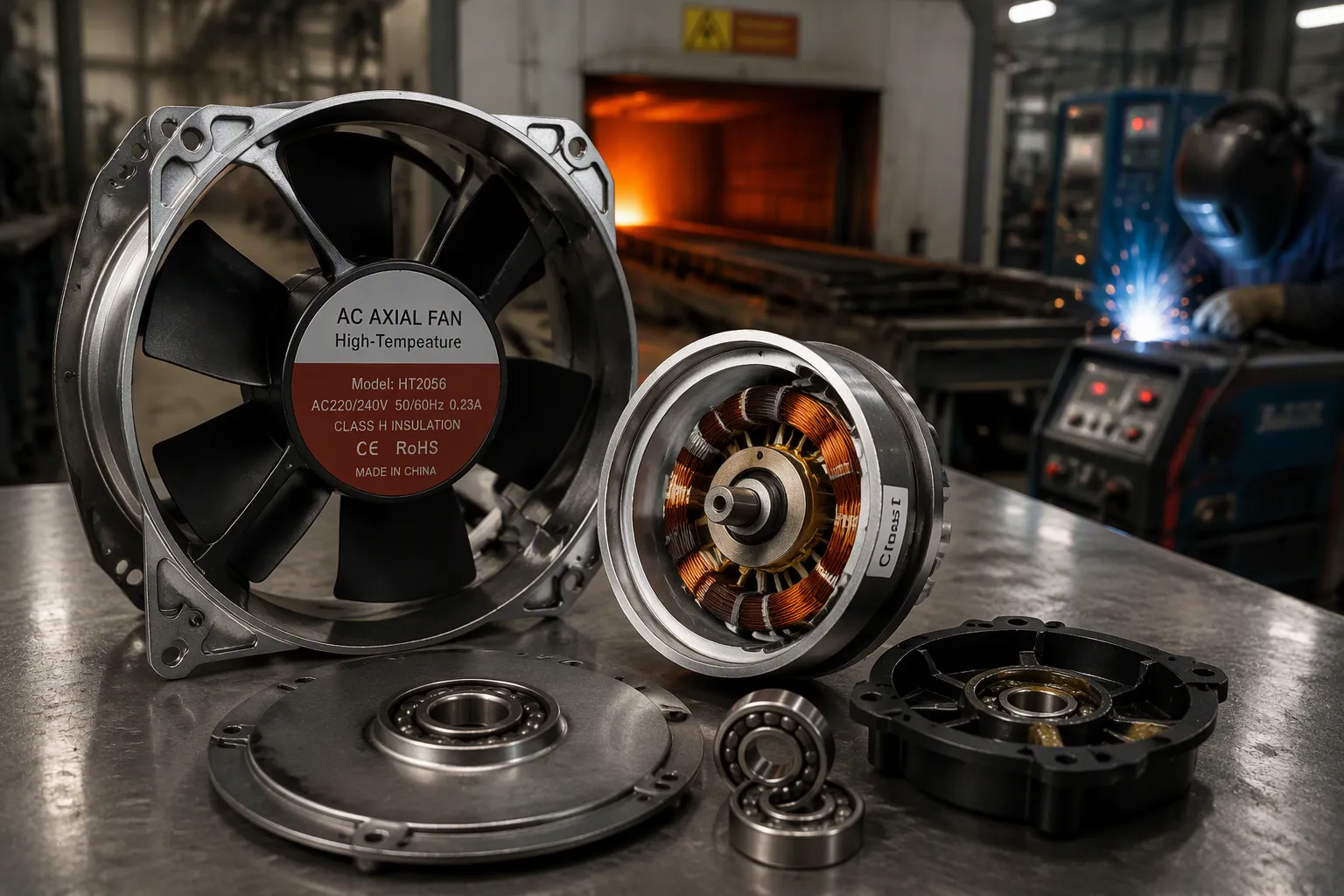
High-temperature resistant AC axial fans fix the problems described above. Aluminum alloy frames, Class F and Class H pure copper windings, and wide-temperature grease ball bearings work together. Each part deals with heat in a different way. Together they keep the fan running in 60°C–80°C environments around tunnel ovens, welding machines, and injection molding machines. The design choices below explain how each part meets that goal.
Metal Frames and High-Insulation Windings
Aluminum alloy frames resist softening much better than plastic. Aluminum keeps its shape at temperatures that make standard plastic housings soft and warped. The frame keeps the impeller lined up and the mounting holes steady. Metal also pulls heat away from the motor, which lowers the coil temperature inside. A warped plastic frame lets the impeller rub the shroud. A metal frame keeps its shape and protects the air gap.
Windings matter just as much. Class F insulation rates the winding for 155°C. Class H insulation raises that ceiling to 180°C. Pure copper wire carries current with lower resistance than aluminum wire, so it makes less heat for the same load. A fan built this way keeps its insulation intact even when ambient heat pushes the coil well above the surrounding air temperature. The enamel stays flexible instead of cracking, and the winding survives the thermal cycling that kills standard motors.
These features suit welding and plasma cutting equipment makers, industrial oven and furnace manufacturers, and die-casting and metallurgy equipment makers. These machines run hot and run long. A fan with a metal frame and Class F or Class H windings matches that duty. The same fan also fits injection molding machines and other plant equipment that sits near a heat source. These buyers need fans that survive the heat cycle after cycle.
Bearings and Lubricants Built for Heat
Bearings decide how long a fan lasts in heat. Sleeve bearings depend on a lubricant film, and that film thins as temperature rises. Ball bearings use hardened steel rolling elements. They handle heat better and hold alignment under load. A ball bearing also starts with less friction, so it runs cooler in the same hot air.
Grease choice matters too. Standard grease dries out and hardens near hot equipment. Wide-temperature grease keeps its consistency across a broad range. It keeps lubricating the bearing instead of baking into a crust. The right grease also resists oxidation, so it does not turn acidic and attack the bearing surfaces.
Ball bearings in a well-specified fan can reach a mean time between failures of about 60,000 hours under 24/7 operation. That figure assumes the bearing and grease match the ambient conditions. A mismatched grease shortens that life sharply. Maintenance teams should treat the grease rating as a hard limit, not a suggestion.
Extreme designs push the limit further. Some specialized fans reach 220°C ambient, a figure Rotron documents for its high-temperature line. That upper end shows what careful material and bearing selection can achieve. Most industrial plants do not need that extreme. They need a fan rated honestly for their real ambient temperature. A fan rated for 80°C will outperform a fan rated for 50°C in the same hot spot, even if both look identical from the outside.
How to Select an AC Axial Fan for High Heat
Matching Temperature Ratings to the Application
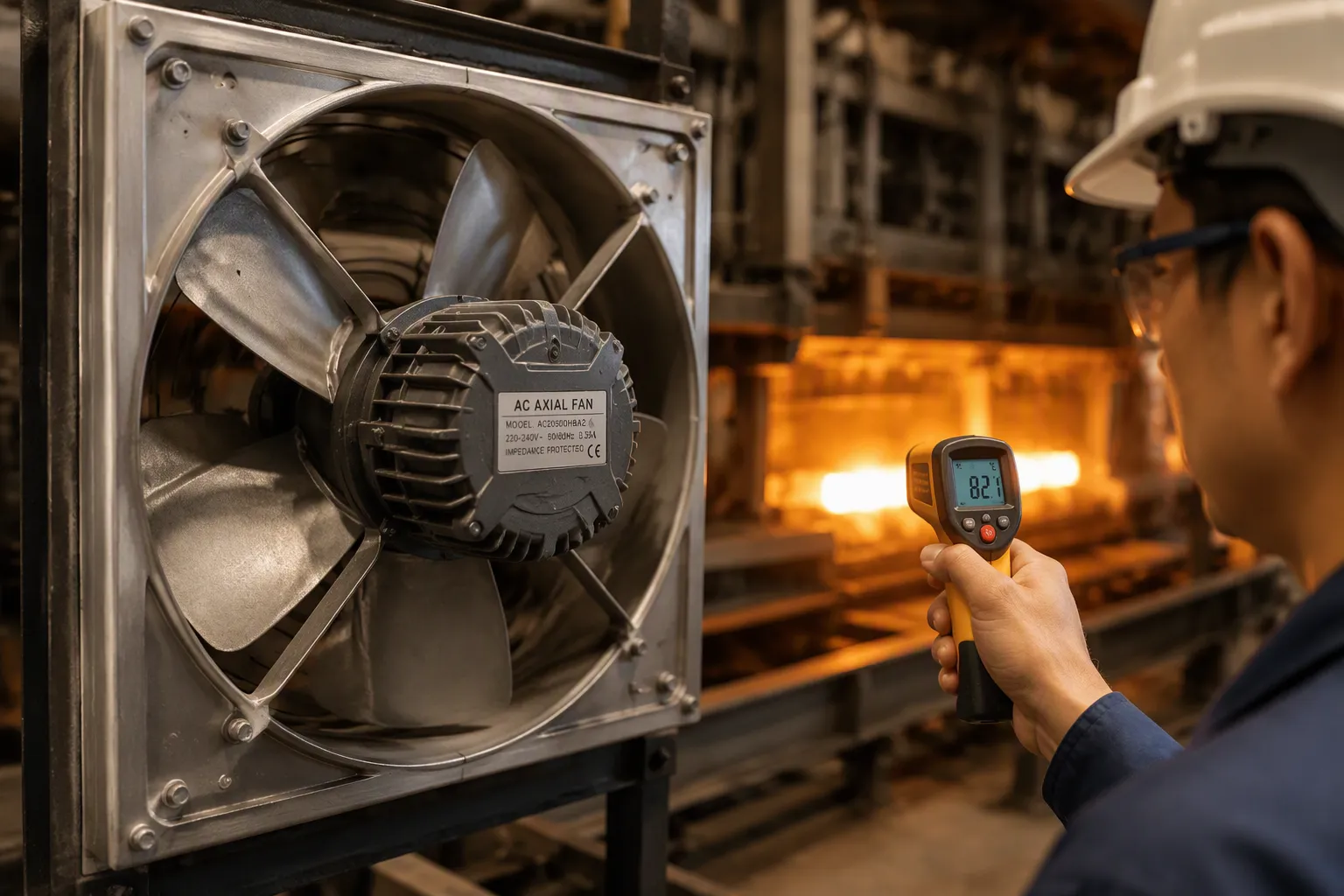
Picking a fan starts with its ambient temperature rating, not how much air it moves. A fan that moves a lot of air still fails fast if its motor, bearings, and housing can't take the heat near tunnel ovens, welding machines, or injection molding equipment. Engineers should first measure the real ambient range where the fan will be mounted. Then they should match the fan to that range, the humidity, and any dust or corrosive conditions.
Motor type sets the limit. All-metal AC axial fan motors can handle ambient temperatures up to 150°C, which makes them the practical choice for industrial ovens, foundries, and furnace cooling. DC motors usually top out at 120°C ambient through PCB potting and encapsulation. EC motors generally handle -25°C to +60°C, and extreme heat is their weak point. A metal-blade AC axial fan often carries a -40°C to +80°C rating for general industrial use, while a standard external rotor fan sits at -30°C to +60°C.
Bearing life follows the same logic. The Arrhenius rule of thumb says every 10°C rise in operating temperature roughly halves bearing grease life. A grease rated 70,000 hours at 25°C may drop to about 2,000–4,000 hours at 70°C motor body temperature. That drop explains why the grease rating deserves as much attention as airflow.
Checking Insulation, Bearings, and Housing
After the temperature rating, check the three parts that decide survival: insulation class, bearing type, and frame material. Class F windings rate 155°C and Class H windings rate 180°C, so both leave headroom above a 60°C–80°C ambient. Ball bearings with wide-temperature grease outlast sleeve bearings in hot air. An aluminum alloy frame holds its shape where plastic softens.
The Belmont Axial Fan range gives a real example. The BMF(K)4E550-Z AC axial fan uses a 550 mm frame, a 230 V supply, and a cold-rolled steel impeller. It delivers 8,500 m³/h with 550 W input and IP54 protection. Belmont builds the wider range from 133 mm to 1,220 mm, so equipment makers can scale the same construction across different machines.
Specification | BMF(K)4E550-Z |
|---|---|
Frame size | 550 mm |
Supply | 230 V, 50 Hz |
Max airflow | 8,500 m³/h |
Power input | 550 W |
Protection | IP54 |
IP54 and IP55 suit dusty or wet plant areas. IP43 fits cleaner indoor cabinets where water jets are not a concern. Belmont also customizes voltage, mounting structure, impeller material, and protective coatings, which helps when a welding or die-casting line needs a fan matched to its own enclosure.
Maintenance That Extends Fan Life in Heat
Inspection and Cleaning Schedules
Heat by itself does not kill a fan. Dust and blocked airflow push the coil temperature higher on top of the ambient heat. A plant near tunnel ovens or welding machines already runs at 60°C–80°C. A clogged guard adds more load that the winding cannot take. Maintenance teams should therefore set a cleaning schedule based on how fast the fan collects debris, not on a fixed calendar.
Each inspection should cover three checks. First, clean the impeller blades and the guard grille so air moves freely. Second, look for warped blades, cracked frames, or rubbing marks on the shroud. Third, confirm that airflow still reaches the equipment and that nothing blocks the intake or exhaust path. A fan that passes these checks keeps its coil cooler and its bearings happier.
Bearing Service and Failure Signals
Bearings fail slowly, and they give warning before they seize. Wide-temperature grease in ball bearings can reach about 60,000 hours of mean time between failures under 24/7 operation. That figure holds only when the grease matches the ambient heat. Teams should relubricate or replace bearings on the interval the grease rating supports, and shorten that interval as the surrounding temperature climbs.
Operators should also listen and measure. A grinding or whining tone points to grease breakdown. Rising vibration suggests wear or imbalance. A current draw above the normal value signals extra friction in the bearing or a dragging impeller. Any of these signs justifies pulling the fan for service before it stops the machine. Catching these signals early protects the aluminum frame, the Class F or Class H copper windings, and the whole production line.
AC Axial Fans vs. Other Cooling Choices in High Heat
Where AC Axial Fans Work Best
An AC axial fan works well in hot plants where air itself does the cooling. Makers of welding and plasma cutting equipment need steady airflow across hot panels and cabinets. Industrial oven and furnace makers need fans that hold up at 60°C–80°C ambient without warping. Die-casting and metallurgy equipment makers need the same toughness near molten metal and radiant heat. A metal-framed fan with Class F or Class H copper windings and wide-temperature ball bearings handles all three jobs. It moves a lot of air at low pressure, which fits open cabinets, oven shells, and machine enclosures.
Axial fans also fit cooling towers and large outdoor heat-rejection units. Belmont supplied a custom EC axial fan to a UK cooling tower maker. The project cut system energy use by about 20% and lowered noise by 6.3 dB(A). The fan used an optimized impeller, a diffuser, and smart EC controls. That case shows where axial designs shine: high-volume airflow, compact mounting, and speed you can control.
When Other Cooling Methods Make Sense
No single fan type wins everywhere. Centrifugal fans make sense when a system needs high static pressure, such as long duct runs or dense filter banks. They push air through resistance that stalls an axial fan. Heat exchangers and closed-loop liquid cooling fit sealed electronics or dusty sites where outside air carries contaminants. Compressed-air vortex coolers suit small enclosures with no room for a fan. Each option has a place, and the right choice depends on pressure, space, and contamination.
Equipment makers should match the method to the job. An AC axial fan remains the practical pick for welding, oven, and die-casting lines that need simple, durable air movement. Buyers who plan for the heat from day one avoid repeat failures later.
You can get reliable high-temperature operation from an AC axial fan. The housing, insulation class, bearings, and lubricant must match the ambient conditions. Near tunnel ovens, welding machines, and injection molding equipment, ambient heat often reaches 60°C–80°C. Standard plastic housings get soft there, and ordinary enameled windings break down.
Equipment makers in welding, industrial ovens, and die-casting should know these failure modes. They should pick metal-framed fans with Class F or Class H copper windings and wide-temperature ball bearings. Maintenance teams should then guard that investment with regular cleaning, inspection, and bearing care.
The practical takeaway is simple. Choose for the heat from day one. A fan built for the environment lasts longer than a standard model swapped in after failure.
Alan Gu General Manager | Hi, I’m Alan Gu, General Manager of Belmont Fan. We specialize in R&D and manufacturing of high-performance axial & centrifugal fans, delivering customized airflow solutions for HVAC, refrigeration, data center and industrial automation sectors. With nearly 10 years of focused engineering practice in fan aerodynamic design, product iteration and global OEM/ODM project delivery, I firmly believe that technological innovation must be built around real-world airflow challenges. I launched this blog to share hands-on engineering know-how: fan type selection, on-site application guidance, non-standard custom airflow solution design, plus system installation & maintenance best practices. We are committed to developing energy-efficient, reliable fan products that cut operational costs and bring tangible value for system integrators and equipment manufacturers worldwide. Let’s explore ventilation engineering, exchange technical insights, and grow together! |

FAQ
What ambient temperature can a metal-framed AC axial fan handle?
A metal-framed AC axial fan with Class F or Class H windings can handle the 60°C–80°C ambient that is common around tunnel ovens, welding machines, and injection molding equipment. Aluminum frames keep their shape even when plastic gets soft. Specialized designs go even higher, and some high-temperature fans are rated to 220°C ambient.
Why do standard plastic-housing fans fail near welding and die-casting equipment?
Plastic housings get soft as the ambient heat rises toward 60°C–80°C. Frames warp, mounting holes stretch, and impellers rub against the shroud. Ordinary enameled windings break down at the same time. The fan often fails before the motor burns out, which is why maintenance teams keep replacing the same model again and again.
Which insulation class should buyers specify for hot plant environments?
Class F rates the winding for 155°C, and Class H raises that ceiling to 180°C. Both leave headroom above a 60°C–80°C ambient, because the coil runs much hotter than the surrounding air. Pure copper wire also makes less heat than aluminum wire at the same load, which helps the winding last longer.
How long do ball bearings last in continuous high-heat duty?
Ball bearings with wide-temperature grease can reach about 60,000 hours of mean time between failures under 24/7 operation. That number depends on matching the grease to the ambient heat. Every 10°C rise in operating temperature roughly cuts grease life in half, so the rating deserves close attention during selection.
Does an AC axial fan fit cooling towers and outdoor heat-rejection units?
Yes. Axial designs fit high-volume, low-pressure airflow in cooling towers and outdoor units. Belmont supplied a custom EC axial fan to a UK cooling tower maker, and the project cut system energy use by about 20% while lowering noise by 6.3 dB(A). Metal construction and IP54 or IP55 protection support outdoor duty.


