


Axial Fans in HVAC Systems and Their Most Common Applications
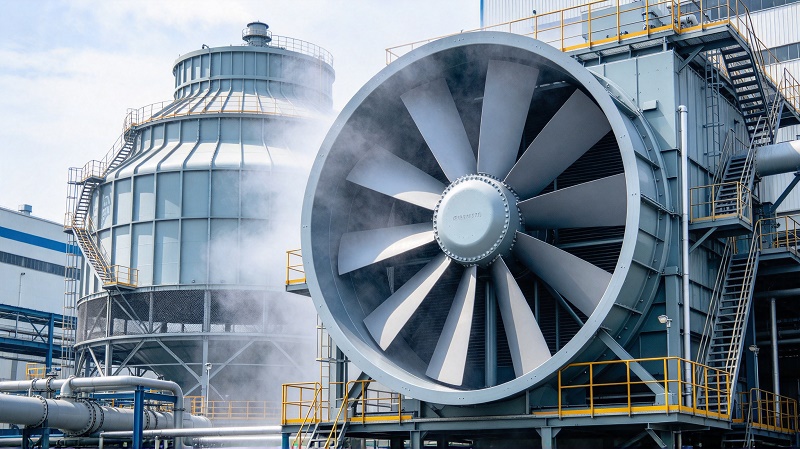
Axial fans help HVAC systems in jobs that need high airflow and low static pressure. Cooling towers, outdoor AC condensers, electronic cooling, and combustion engine cooling all rely on this axial fan HVAC approach. The global axial fan market was USD 2.89 billion in 2024. It will grow to USD 5.09 billion by 2034, showing rising demand for efficient air movement. This article explains what an axial fan is and covers each common use of axial fans. Readers will get useful insight into how these devices help with ventilation and thermal management across many HVAC settings.
Key Takeaways
Axial fans push air straight ahead and quickly, making them great for cooling towers and AC condensers.
They use less energy and take up less space, making them a smart choice for HVAC systems.
EC motors use up to 30% less power and change speed on their own.
These fans easily cool electronics and engines, and they ventilate buildings.
Belmont offers custom axial fans from 200 mm to 910 mm for different needs.
Axial Fans: Overview and Benefits
What Is an Axial Fan?
These units push air in a straight line, parallel to the impeller shaft. This straight airflow works like a propeller moving air forward. The design allows high volume and low static pressure. Air moves short distances with very little resistance. This makes the unit useful in axial fan HVAC applications, like cooling towers and condensers.
Engineers pick this fan type when there is not much space. Its compact, lightweight build makes wall mounting and setup easy. Centrifugal fans need more room and turn the airflow at a 90-degree angle. The main differences between axial and centrifugal fans are pressure, airflow volume, and space limits. Axial units move large amounts of air at low pressure. Centrifugal fans create higher pressure with lower flow. These differences between axial and centrifugal fans help guide design choices. Looking at pressure and airflow needs helps engineers know how to choose the right fan. For simple, low-pressure jobs, an axial unit often gives the best value.
Key Benefits in HVAC Systems
The main benefits of axial fans are their compact size, strong air volume, energy efficiency, low noise options, and easy setup. These benefits of axial fans explain why they are so popular among HVAC fan types. EC motor technology adds variable-speed control. Output then matches demand and cuts wasted energy. Heating, ventilation, and air conditioning can use up to 40% of a building’s total energy. So, efficient fan operation lowers operating costs by a lot.
Axial units also run quietly at lower speeds. In hospitals and offices, equipment below 40–50 dB is suggested. Their compact shape makes installation less complex. This simplicity lowers maintenance needs and total cost of ownership. Among HVAC fan types, axial units are lighter and need less structural support. These features show the advantage: high volume at low pressure versus higher pressure with reduced flow.
Axial Fan HVAC Applications in Cooling Towers and Condensers
Cooling Towers
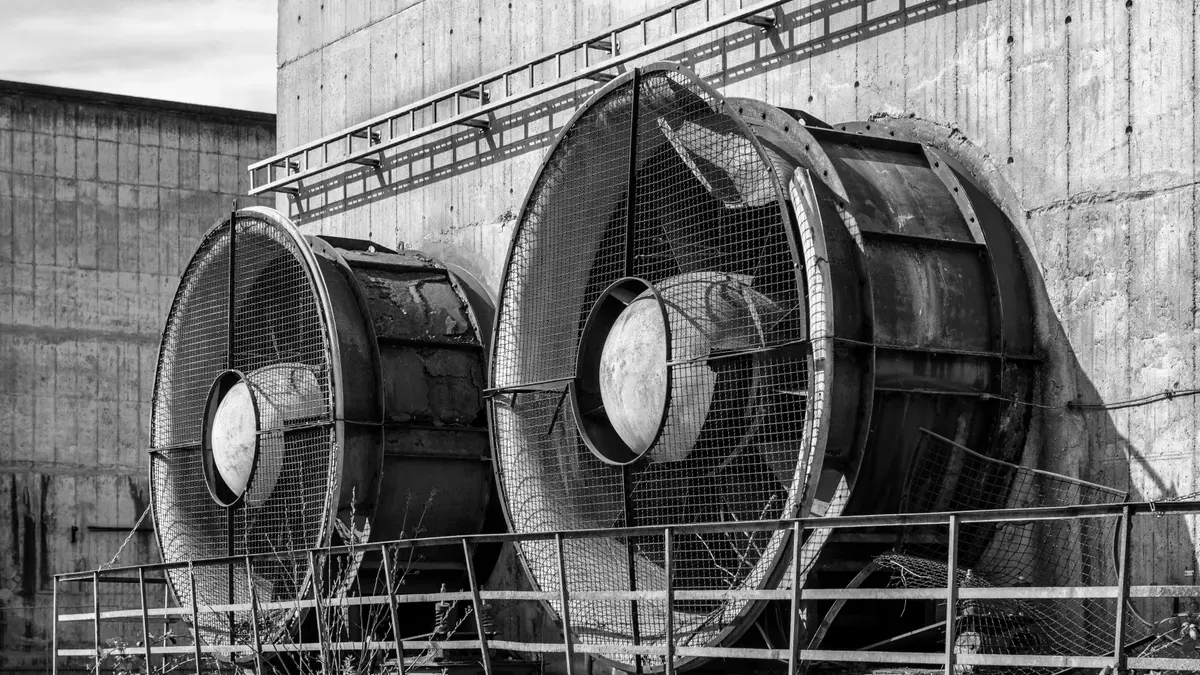
Cooling towers remove heat from water used in HVAC and industrial processes. These systems need huge amounts of air with very little resistance. An axial fan HVAC design matches this need perfectly.
Axial fans push air parallel to the shaft, so they work well for high-flow, low-pressure jobs. Propeller-type axial fans are used in cooling towers, exhaust systems, and simple ventilation.
Cooling towers are low-pressure applications, so system resistance stays low. Air moves through fill material and drift eliminators with little blockage. Axial fans provide the airflow needed without wasting energy on extra pressure.
Baltimore Aircoil says axial fans in cooling towers can do the same job with about half the horsepower of centrifugal fans in similar setups. This efficiency gain explains why so many places use them.
Outdoor cooling towers expose fans to wind, dust, humidity, and temperature changes. Makers suggest at least IP54 ingress protection to stop short circuits and rust. Coated IP55 versions keep out moisture and particles. Their aerodynamic blade design also cuts frost buildup on heat exchangers.
Corrosion resistance is important in cooling tower environments. A full composite coating serves as the primary corrosion barrier. For cooling tower water with high chloride and fluoride levels, optional materials include 316L stainless steel, 904L stainless steel, duplex, Teflon, and Monel.
Outdoor AC Condensers
Outdoor air conditioner condensers use axial fans to move air across condenser coils. This airflow removes heat taken in from indoor spaces. The fan pulls air through the coil and releases heat well.
Axial fans sit on top of rooftop units or inside home compressor sections. Condenser coils need air movement to release heat. They do not need a powerful or costly fan. An axial fan is the best choice for this job.
A cracked or unbalanced axial fan can cause too much vibration, loud noise, or even compressor overheating. Its aerodynamic design gives maximum airflow with minimal noise, helping keep cooling performance steady.
Typical axial fan peak airflow for outdoor condenser units ranges from 4,000 to 30,000 m³/h, depending on diameter and pitch. Fan diameters for outdoor units usually span 450 to 850 mm. One example uses a 450 mm impeller delivering 7,004 m³/h at 1,350 RPM with 480 W input power.
Belmont's axial fans work for cooling towers and condensers with IP54 and IP55 protection for tough environments. The 300mm Reliable EC Axial Fan for Condenser (model BEFEC92-A300-1B38) delivers 1500 m³/h airflow at 2100 RPM with 130 W power use and 68 dB(A) noise. This EC motor technology saves up to 30% energy compared to traditional AC fans. The fan runs reliably at ambient temperatures from -20°C to +60°C.
Axial Fans for Electronic and Engine Cooling
Electronic Equipment Cooling
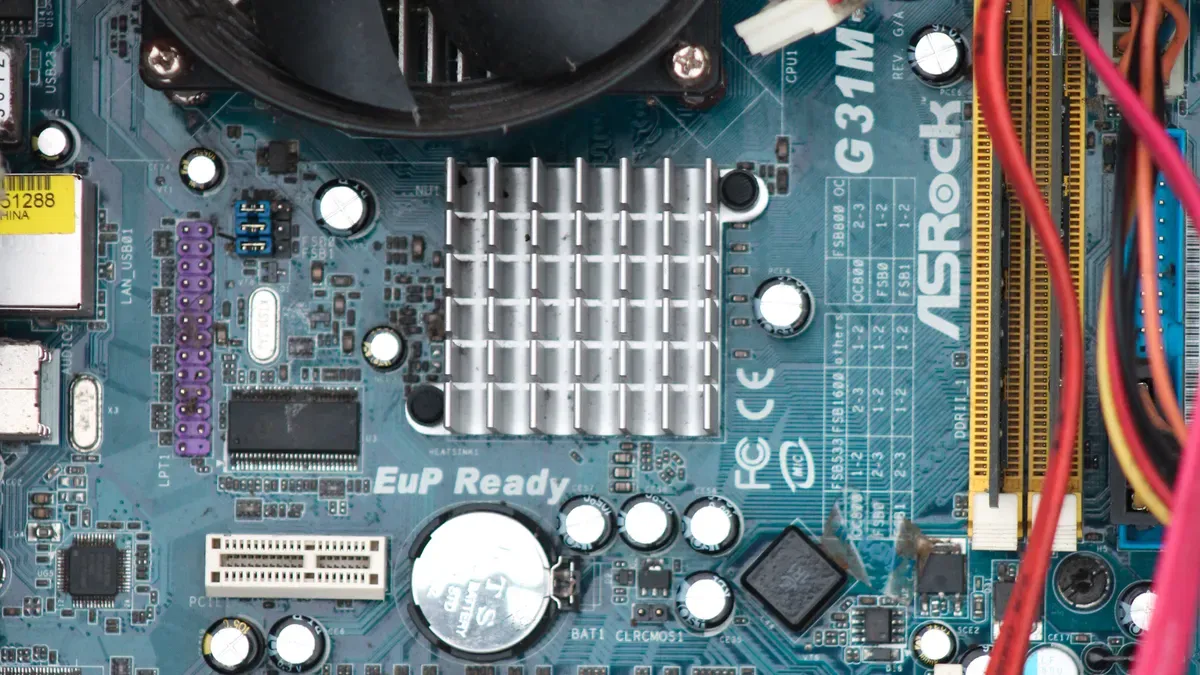
Electronic equipment makes heat while it runs. Telecom cabinets, data centers, electrical cabinets, and industrial automation equipment all need steady airflow to stay within safe temperature limits. An axial fan moves air straight across parts that make heat. This direct path works well in enclosures where space is tight and resistance is low.
Some common applications of axial fans include cooling towers, outdoor air conditioner condensers, electronic component cooling and combustion engine cooling.
Where you place the fan matters as much as which fan you pick. Axial fans should push air out at the top and pull cooler air in at the bottom. Top exhaust works with natural convection and is 15–20% more effective at the same CFM than an intake-mounted fan. A 120 mm axial fan moving 100 CFM can remove about 100–200 W, depending on the internal-to-ambient temperature difference. When cabinets must keep IP54 or IP55 protection, filtered inlet and exhaust systems become necessary. Filters need regular checks because a clogged filter blocks airflow and gives false protection.
Data center cabinets need higher airflow rates. A 200 mm × 70 mm axial fan can deliver a maximum free-air airflow of 1084 CFM with a maximum static pressure of 5.40 inH₂O. It draws 384 W at 48 VDC and makes 81 dBA of noise. Typical operating airflow in a real system falls between roughly 700 and 1000 CFM. Engineers estimate required airflow from heat removal and allowable temperature rise. For a 20 kW load with a 10 °C rise, the calculation is 20 kW ÷ (20 × 10) ≈ 100 m³/min ≈ 3530 CFM. This airflow spreads across about 4–6 large rear-door heat exchanger fans. Free-air ratings cannot be used directly because fans work against coil pressure drop and enclosure resistance.
Belmont's axial fans serve electronics cooling, data centers, and new-energy systems like solar inverters and EV chargers. EC motors bring clear advantages for continuous-duty cooling. EC motors are highly efficient, so less input energy turns into heat and sound. This lowers the heat load in electronic cooling applications. Lower operating temperatures reduce stress on windings and bearings, which extends motor life. EC motors can turn down to 20% of full speed while keeping about 85% efficiency. EC fans are typically 20–30% more efficient than similar AC fan motors. They have built-in electronic speed control, so airflow changes without an external VFD. With no belts, shafts, or greased bearings to maintain, EC fans need less maintenance in always-on applications.
Combustion Engine Cooling
Combustion engines make intense heat that must dissipate continuously. Axial fans create airflow across the radiator core, radiator condenser, or oil cooler. They are preferred where high volumetric flow and compact depth are needed. Spot cooling of heat-generating equipment such as generators or transformers also relies on this fan type. Cooling large diesel engines and engine fluids requires a large volume of air blowing over the engine. The manufacturer's application guide explicitly lists EC axial fans for automotive engine and radiator cooling. These fans maintain airflow to prevent overheating and ensure reliable operation. EC axial fans with intelligent control circuits automatically adjust speed based on thermal requirements. They increase airflow only when needed and reduce it when conditions stabilize. MagLev-bearing EC fans reduce mechanical vibration and wear, extending service intervals and reliability.
Other Common Axial Fan Uses in HVAC
Ventilation and Exhaust Systems
Axial fans help with ventilation and exhaust in homes, businesses, and factories. They move a lot of air through ducts or open spaces with little resistance. In office buildings, shopping malls, and factories, these fans bring fresh air in and push old air out. Industrial facilities use them to remove dust, fumes, and airborne contaminants from work areas. Exhaust systems in paint booths, chemical storage rooms, and food processing plants depend on axial fans to remove hot air, smoke, and chemical fumes. Parking garage ventilation and atrium air circulation also rely on this fan type. When you need to move a lot of air for general ventilation, axial fans work well because they push air in a sheet parallel to the rotation axis. Duct boosting, bathroom exhaust, and kitchen exhaust are other common industries & applications for these fans. Axial and centrifugal fans differ in pressure capability and airflow direction. Axial units fit large, open spaces that need massive airflow at lower pressure. Centrifugal fans handle ducted systems and dusty air with higher pressure needs.
Air-Cooled Heat Exchangers
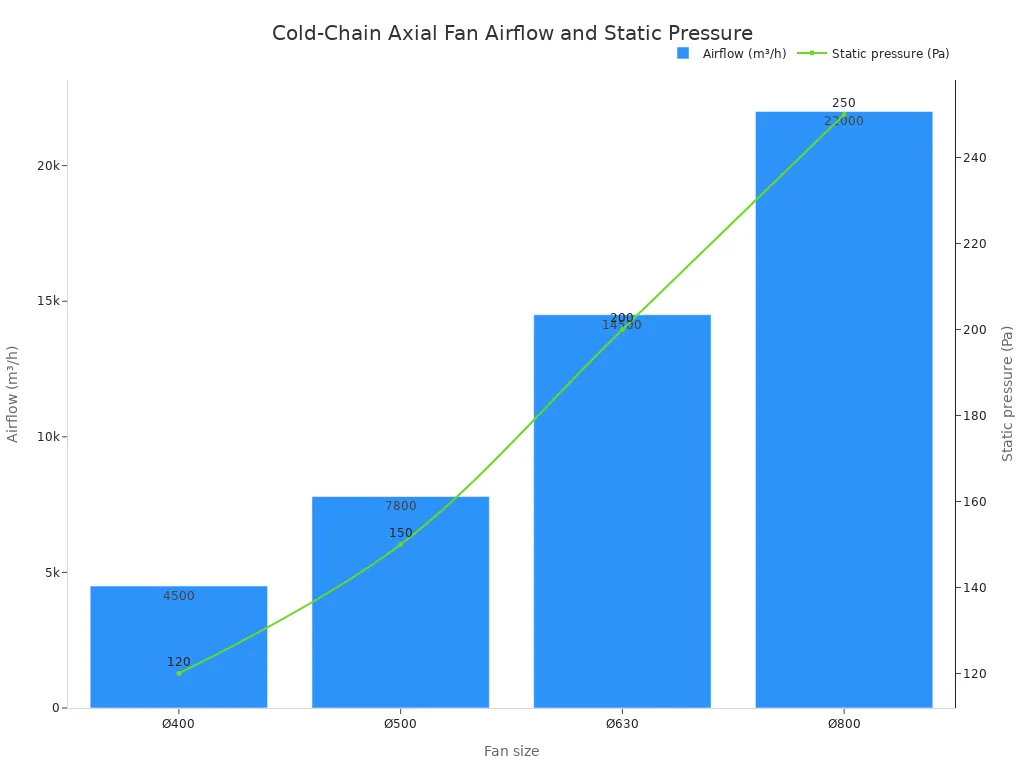
Air-cooled heat exchangers and refrigeration systems use axial fans to move air through evaporator coils. This airflow helps heat exchange and cools the refrigerated space. Cold storage and cold-chain logistics depend on steady airflow to keep product quality. For cold-store unit coolers, you calculate required airflow from evaporator refrigeration capacity and the air temperature split. A 10 kW unit cooler with a 10 K split needs about 2,750 m³/h. The fans you pick must provide this combined airflow at the system static pressure. Larger fan diameters give proportionally higher airflow and static pressure for supermarket condensing units and logistics-center condensers.
Belmont's axial fans serve AHUs, refrigeration, cold rooms, and general ventilation. The company offers OEM/ODM support with customization options for voltage, airflow, mounting structure, and control features. Impeller material customization and special coatings are also available. These options help commercial HVAC systems meet specific project requirements.
Axial fans do six main jobs in HVAC systems. They push air through cooling towers, outdoor AC condensers, electronic cabinets, combustion engines, ventilation systems, and air-cooled heat exchangers. Every job needs high airflow at low static pressure. The axial fan hvac design gives exactly that mix. A compact frame fits into tight equipment spaces. EC motors bring strong energy efficiency and steady speed control.
These features keep temperatures steady and equipment running. One axial fan can cool a condenser or a data cabinet with the same reliability. Belmont makes axial fans from 200 mm to 910 mm with AC and EC options. The company backs OEM projects with 24 years of experience. Belmont stands as a trusted partner for axial fan solutions around the world.
FAQ
What is the difference between an axial fan and a centrifugal fan?
Axial fans push air in a straight line along the fan shaft. They give strong airflow at low static pressure. Centrifugal fans turn the airflow 90 degrees and make higher pressure with less flow. Engineers pick axial units for cooling towers, condensers, and open ventilation spaces.
Which axial fan sizes does Belmont offer?
Belmont makes axial fans that range from 200 mm to 910 mm across. You can choose from AC and EC motor options. Top airflow can hit 32,000 m³/h, based on the model. Buyers pick small units for equipment cooling or big fans for industrial airflow.
How much energy can an EC axial fan save?
EC motor technology lowers energy use by as much as 30% versus old AC fans. EC motors stay at about 85% efficiency even at 20% speed. That makes them great for always-on jobs like data centers and refrigeration systems.
What protection ratings do Belmont axial fans carry?
Most Belmont axial fan models come with IP54 protection. Some heavy-duty versions offer IP55 ratings. These ratings fit tough places like cooling towers, outdoor condensers, and industrial ventilation systems where moisture and dust show up.
Can Belmont customize axial fans for specific applications?
Yes. Belmont gives OEM and ODM support, with customization for voltage, airflow, mounting structure, impeller material, and control features. The company also offers help with selection and technical support. Standard models usually ship in 7–15 working days.


