


Axial Fan Noise Reduction: How to Meet Hospital and Office Acoustic Requirements
Acoustic comfort helps patients heal and helps employees stay focused. The World Health Organization suggests strict noise limits for hospital rooms:
Steady background noise: 30 dB LEq all day and night
Loudest noise at night: 40 dB
Offices usually aim for NC-30 to NC-40 standards. Your HVAC system's axial fan often becomes the main noise problem, upsetting these sensitive sound environments.
This guide gives you practical ways to reduce noise. You will learn how to find noise sources, install parts correctly, choose silencers, and use real-world fixes. Using proven engineering methods and expert advice, including Belmont's quiet EC axial fans, you can meet the rules without losing airflow performance. Choosing the right fan size and using smart controls help you hit acoustic targets while saving energy.
Key Takeaways
Pick the right fan size so it doesn’t have to spin too fast. Fast spinning makes a lot more noise. A fan that fits well moves air without being loud.
Use anti-vibration mounts and flexible duct connections. These parts stop noise from moving through the building. This easy step reduces low-frequency rumble.
Pick silencers that match your fan's exact noise. Use reactive silencers for low sounds and dissipative silencers for high sounds. A hybrid system handles every pitch.
Slow the fan down when you can. Smart controls lower its speed during quiet hours. This cuts noise and saves power.
Treat the room, not just the fan. Add soft surfaces like acoustic panels and baffles. These materials soak up sound and cut down echoes.
Axial Fan Noise Factors
Speed and Aerodynamic Noise Generation
Fan speed is the biggest cause of noise. The link between RPM and sound is not simple—it grows very fast. If you double the speed, the sound can jump by 15 dB or more. So even a small drop in speed can make a big difference in noise.
Choosing the right fan size stops you from needing high speed. Look at the Belmont 500mm EC axial fan. It runs at 1600 RPM and moves 9800 m³/h of air. This shows how good design can give high airflow without extreme speed. Pick a fan that fits your real airflow needs, and you avoid extra noise.
Noise from airflow comes from turbulence, blade-pass interactions, and stall. Turbulence happens when air flow is disturbed at the inlet or outlet. Blade-pass interactions occur when rotating blades create pressure changes against fixed parts. Stall happens when airflow separates at high angles of attack, making broadband noise.
Mechanical parts also add noise. Imbalance causes low-frequency rumble. Misalignment creates whine at running speed multiples. Bearing wear produces tonal harmonics. Loose parts amplify vibration. You must fix both airflow and mechanical issues for full noise control.
Blade Design and Tonal Frequency Control
Blade pass frequency (BPF) is the main tonal noise in most axial fans. You find it by multiplying the number of blades by the speed. This tone stands out from random noise and bothers people more.
Manufacturers use two ways to manage BPF. Uneven blade spacing spreads noise energy across a wider range. This breaks up the strong tone into softer parts. Optimized airfoil shapes reduce the pressure changes that cause tonal noise.
Belmont uses CFD-optimized blade designs in its EC axial fans. These shapes reduce turbulence and stall at the blade surface. Precision dynamic balancing lowers vibration noise. The result is a quieter fan that still moves the needed air.
When checking fan noise, know the difference between sound power and sound pressure. Sound power level (Lw) is the source's total acoustic output, no matter where you stand. Sound pressure level (Lp) is what you hear at a specific spot, affected by distance and room reflections. A report that only says "dB(A)" does not show which one it means.
Quantity | Definition | Reference Value |
|---|---|---|
Sound Power Level (Lw) | Source's total acoustic output | 1 pW |
Sound Pressure Level (Lp) | Sound at a specified position | 20 μPa |
Always ask for octave-band data when comparing fans. Full-octave measurements from 63 Hz to 8000 Hz show if a pure tone exists. This helps you pick silencers that target the exact frequencies your fan makes.
Installation and Environmental Impact
Anti-Vibration Mounts and Duct Isolation
Mechanical vibration moves through the building as structure-borne noise. You hear this as a low rumble even when you are far from the fan. Spring isolators or rubber mounts stop this path. They separate the fan from the floor or wall, cutting transmitted vibration by 3–8 dB(A) when structure-borne transmission exists. Without these mounts, the fan's vibration shakes the whole building frame.
Flexible duct connections also matter. Rigid metal ducts pass vibration easily. A short piece of flexible canvas or rubber between the fan outlet and the rigid duct blocks this path. You also stop the fan's mechanical energy from shaking the duct panels themselves. This cheap addition gives real noise reduction.
The Belmont customer story shows another installation benefit. A Spanish HVAC manufacturer switched to pre-assembled, integrated EC axial fan designs. These units came with grilles, flanges, and airflow parts already mounted. The installation team saved 30% of their assembly time. Fewer on-site connections also mean fewer chances for misalignment and loose joints that cause noise.
Installation Factor | Noise Reduction Effect | Key Condition/Note |
|---|---|---|
Anti-vibration mounts | 3–8 dB(A) | Only if structure-borne transmission is present |
Speed reduction (70% of full load) | 7–10 dB(A) | Fan still moves adequate air for most conditions |
Duct lining (25 mm mineral wool, 1-metre run) | 5–10 dB(A) at mid/high frequencies | Adds resistance; check fan curve |
Flow straighteners at inlet | Reduces broadband and tonal noise | Reduces turbulence before blade |
Inlet Conditions and Room Acoustics
Turbulent inlet airflow raises noise a lot. When air enters the fan with swirl or uneven speed, the blades meet changing pressure conditions. This creates broadband noise and can excite tonal parts. You need straight duct runs upstream of the fan. A straight section of at least three to five duct diameters lets the airflow settle before reaching the impeller. Flow straighteners help more by removing swirl and evening out velocity across the duct cross-section.
Room acoustics also make perceived noise louder. Hard-walled rooms with concrete floors and glass windows reflect sound energy. Each reflection adds to the sound pressure level at the listener's spot. A fan that measures 45 dB(A) in a free-field test can sound clearly louder in a reverberant hospital corridor or open-plan office.
The WHO guidelines for hospitals require careful attention to both source and path noise control. You cannot just install a quiet fan and expect compliance. The room itself must support acoustic comfort. Acoustic ceiling tiles, wall panels, and carpet absorb sound energy and cut reverberation time. These treatments work with the fan-side measures you have already put in place.
Your axial fan installation strategy must therefore cover three paths: the mechanical path through the structure, the aerodynamic path through the ductwork, and the acoustic path through the room. Each path needs different countermeasures. Handling all three at once ensures you meet the strict acoustic requirements of healthcare and office environments.
Axial Fan Silencer Types
Silencers come in two main types: passive and active. Passive silencers use sound-absorbing materials and winding paths to reflect, absorb, and scatter noise without needing power. Active silencers use microphones, a controller, and speakers to send out sound waves that cancel the original fan noise. For most HVAC setups, passive silencers are the most practical and budget-friendly choice. You can get them in round or rectangular shapes, made for inlet or discharge use, and they work with both axial and centrifugal fans.
Dissipative Silencers for Broadband Noise
Dissipative silencers, also called absorptive silencers, use porous materials like fiberglass or mineral wool to turn sound energy into heat. This method works best for broadband noise in the mid-to-high range of 500–4,000 Hz, which matches the usual frequency range of HVAC fan noise. As sound waves pass through the porous material lining the duct walls, the material absorbs the acoustic energy. This makes dissipative silencers the most common and affordable choice for standard HVAC uses.
You can get broadband reduction of 15 to 25 dB across the 100 Hz to 5,000 Hz range when you place these silencers inline at blower intake and exhaust openings. They control the high-frequency tonal screeches and air-shearing noise that often cause axial fan complaints.
Tight spaces create a challenge. Traditional acoustic liners use a hard-backed honeycomb and a micro-perforated plate, forming a single-degree-of-freedom liner. These liners produce a narrow absorption range, with maximum absorption happening only at a resonant frequency tied to the honeycomb depth. In short duct lengths, such traditional liners often fall short. A combined structure using a phase-modulating metasurface can boost noise-reduction performance, especially for narrowband noise like that from axial fans.
Reactive Silencers for Low-Frequency Tones
Reactive silencers work in a different way. They use geometry—expansion chambers, Helmholtz resonators, and quarter-wave tubes—to bounce acoustic energy back toward the source. This impedance mismatch cancels noise effectively below 500 Hz, where dissipative materials lose their effectiveness. Reactive silencers also suit dirty airstreams because they contain no absorbent material that could clog or break down.
Resonator silencers use tuned cavities to cancel specific frequencies. They appear less often for fans because axial fan noise spans a broad range, but they work well as duct silencers when you know the dominant tone.
Combining Both Types
Hospitals and offices need reduction across both low and broadband frequency ranges. Single-technology silencers cannot fully provide this coverage. A hybrid system places reactive elements for low-frequency control and dissipative sections for broadband reduction. This approach achieves full noise reduction while cutting overall system length by 25–40% compared to single-technology solutions.
Silencer Type | Effective Frequency Range | Mechanism | Role in Hybrid System |
|---|---|---|---|
Reactive | Below 500 Hz | Impedance mismatch reflects acoustic energy | Handles low-frequency tonal noise |
Dissipative | 500 Hz – 8 kHz | Porous materials convert acoustic energy into heat | Handles broadband mid-to-high frequency noise |
Hybrid | Extended frequency spectra | Strategic positioning of both types | Achieves comprehensive noise reduction |
Cross-talk prevention matters in hospitals, executive offices, and conference rooms. Conversations traveling through shared ductwork must be blocked. Hybrid silencers address both the low-frequency hum and the speech-frequency range. Hospitals also avoid internal duct liners due to hygiene concerns, so they rely on external insulation combined with silencers. Hybrid designs provide the needed acoustic performance without harming cleanliness.
Applying Silencers with Belmont EC Axial Fans
Matching Silencer Performance to Fan Output
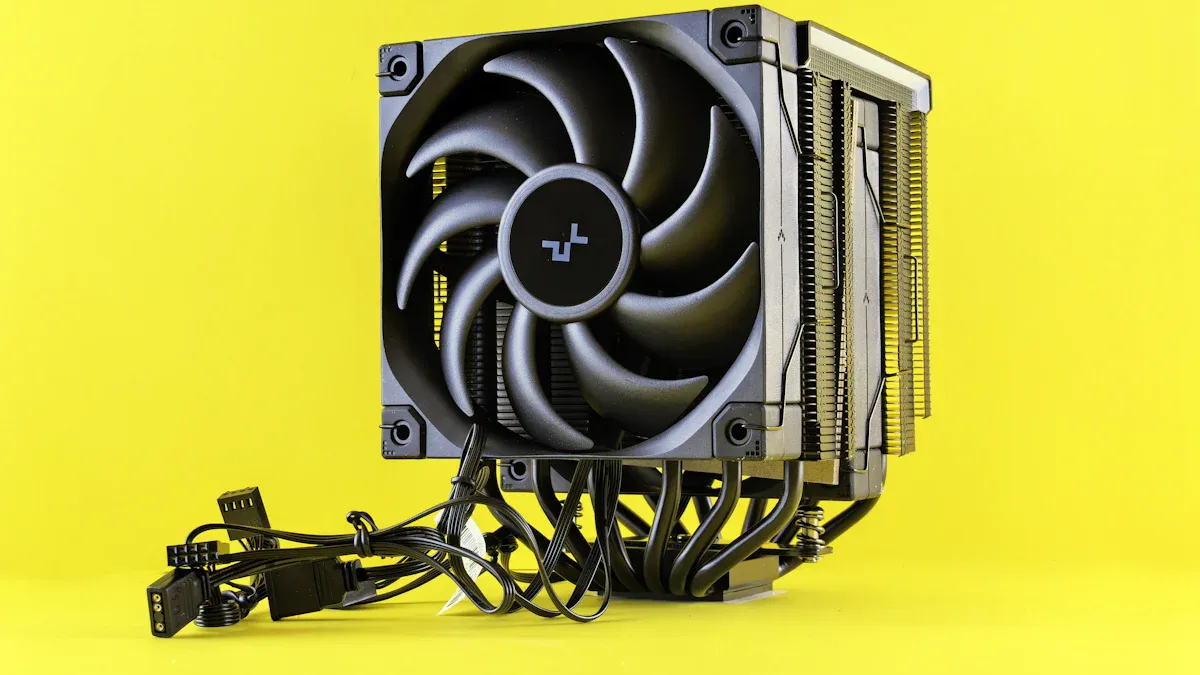
Your noise reduction plan must start before you pick a silencer. The best way is to choose a quiet fan from the start. The Belmont 500mm Low-noise 3 Phase EC Axial Fan can save up to 30% more energy than older AC models. Its smart blade shape and balanced blades create less turbulence and vibration at the source. When you begin with a quieter fan, your silencer has less work to do. You can reach your target noise level with a smaller, less restrictive attenuator.
You must match silencer performance to the fan's real acoustic output across the operating range. A silencer sized for maximum airflow at full speed may work poorly at partial load. On the other hand, a silencer tuned for partial-load conditions may cause too much pressure drop when the fan runs at full capacity. Ask your fan manufacturer for octave-band noise data. Compare this data against the silencer's insertion-loss specs at each frequency band. This matching process ensures you reduce the main tones your fan produces. You avoid wasting space and budget on frequencies that do not matter.
EC Axial Fans minimize noise problems through a direct-drive setup. By removing belts, pulleys, and multiple bearings, vibration levels are greatly reduced. Fewer moving parts mean that mechanical disturbances are less likely, and noise levels are lower—particularly valuable in noise-sensitive environments like offices and schools.
The direct-drive design removes belt-related friction and mechanical noise. This leads to quieter operation at all loads, including partial load. This mechanical simplicity means your silencer only needs to handle aerodynamic noise. It does not need to deal with a mix of mechanical and airflow sources.
Integration with Smart Control Systems
Lower fan speed usually helps reduce noise, especially in applications where the system can ease off for much of the day. This happens often in variable-occupancy buildings where partial-load operation is common. Hospital wards see less activity at night. Office buildings experience lower occupancy during evenings and weekends. Your fan system should respond to these changing conditions automatically.
The Belmont EC axial fan supports 0-10V, PWM, and MODBUS speed control interfaces. These options let you match fan output precisely to real-time system demand. When occupancy drops, the fan slows down, and noise decreases proportionally. A Spanish HVAC manufacturer experienced this benefit directly. After switching to Belmont EC axial fans, their systems measured 5.7 dB(A) lower sound levels. This improvement came partly from the fan's efficient design and partly from intelligent speed control that reduced output during low-demand periods.
Silencer placement matters as much as silencer selection. You must keep adequate straight duct length between the fan and the attenuator. Installing a rectangular attenuator too close to the axial fan inlet or discharge disturbs airflow. This creates swirling and non-uniform velocity profiles. This disturbance increases pressure losses, raises noise, and reduces fan efficiency.
Practice | Placement Guidance | Outcome |
|---|---|---|
Incorrect | Installing a rectangular attenuator too close to the axial fan inlet or discharge | Disturbed airflow, swirling and non-uniform velocity profile, increased pressure losses, higher noise, reduced fan efficiency |
Correct | Allowing an adequate straight duct length between the axial fan and the attenuator | Stabilized airflow, improved acoustic performance, maintained fan rated efficiency, reduced vibration and operational issues |
Belmont offers customizable options that optimize system performance. Integrated diffusers and guide vanes straighten airflow before it reaches the silencer. These components reduce turbulence and improve the silencer's effectiveness. When you combine a low-noise EC fan, intelligent speed control, proper silencer placement, and customized airflow components, you achieve comprehensive noise reduction that meets hospital and office acoustic requirements without sacrificing energy efficiency or airflow performance.
Additional Considerations for Sensitive Spaces

Addressing Reverberation and Background Noise
A quiet fan and good silencers only fix part of the problem. Rooms with hard walls, concrete floors, and glass windows bounce sound around instead of soaking it up. Each bounce makes the noise louder for people in the room. You can measure this with reverberation time, or RT60. This number shows how many seconds it takes for sound to drop by 60 decibels after the noise stops.
Your RT60 goal depends on the room type. Hospital patient rooms should hit 0.4–0.6 seconds based on FGI Guidelines. Private offices and meeting rooms follow BS 8233 with the same 0.4–0.6 second target. Open-plan offices need a drier space at 0.3–0.5 seconds to cut distractions between workstations.
You reach these goals with surface treatments. Acoustic ceiling baffles work great in open ceilings. These vertical panels let sound hit both sides, breaking up reflections and cutting reverberation time a lot. PET felt baffles have an NRC rating of 0.85–0.95, meaning they absorb almost all sound that touches them. Acoustic wall panels reach 0.80 absorption and fit conference rooms and teleconference spaces. Compare that to glass partitions, which rate only 0.05 and reflect nearly everything.
Smart placement fixes most acoustic issues. Soft surfaces at first reflection points handle about 80% of perceived noise problems. Put panels where sound bounces first, not spread randomly around the room.
Auxiliary Components and System-Level Approach
Your HVAC system has more noise sources than just the fan. Dampers and grilles create aerodynamic noise from airflow turbulence. Per ASHRAE guidelines, doubling duct velocity raises aerodynamic noise by about 18–20 dB. Closing several supply vents at once boosts static pressure, strains equipment, and increases noise levels.
Variable-speed blowers help here. They run at lower speeds most of the time, moving air steadily. Less air flow through ducts means much less noise compared to standard on/off blowers.
You need a full system-level approach. Match silencer types to specific noise paths. Absorptive silencers handle broadband reduction for most systems. Lined silencers fit airstreams with moisture or contaminants, making them good for healthcare settings. Reactive silencers without media work in operating rooms and cleanrooms. Acoustic louvers offer transmission loss with 25–30% free open area for ventilation openings.
Build quality matters just as much. Use two layers of overlapping drywall, seal all joints with non-hardening caulk, and fill stud cavities with sound-absorbing material. These steps improve field noise isolation a lot.
Belmont's EC fans support this approach through reliable operation. IP54 protection and F-class insulation ensure steady performance in tough environments. This reliability cuts maintenance-related noise issues from worn bearings or loose parts over time.
You now have four clear steps to follow. First, pick the right fan size and speed to cut down on aerodynamic noise. Second, set up proper isolation and duct design. Third, choose silencer types based on frequency analysis. Fourth, think about the whole system, including room acoustics and auxiliary components.
Meeting hospital and office acoustic requirements is possible. Smart fan selection, strategic installation, and proper silencer application work together effectively. Modern EC axial fan technology, such as Belmont's 500mm low-noise model, delivers both energy efficiency and noise reduction. This dual benefit makes compliance more attainable than ever.
Talk with acoustic engineers or fan manufacturers for site-specific recommendations. Review product datasheets and performance curves before making final decisions. Your next quiet HVAC project starts with informed choices.
FAQ
How do I choose the right axial fan size for low noise?
Pick a fan that fits your real airflow needs, not your biggest guess. The Belmont 500mm EC axial fan moves 9800 m³/h at 1600 RPM. The right size stops the fan from running too fast, which makes much more noise. Check performance curves to confirm airflow at your system's static pressure.
What silencer type works best for axial fans?
Most axial fans need hybrid silencers. Reactive parts handle low-frequency tones below 500 Hz. Dissipative parts absorb broadband noise from 500 Hz to 8 kHz. Match the silencer's insertion-loss data to your fan's octave-band noise spectrum for the best results.
How much noise reduction can EC fans provide?
EC fans cut noise through smart design and speed control. A Spanish HVAC manufacturer saw 5.7 dB(A) lower sound levels after switching to Belmont EC axial fans. Lowering speed during partial-load operation helps a lot. The 500mm model also saves up to 30% energy compared to AC alternatives.
What installation mistakes increase fan noise?
Putting silencers too close to the fan disturbs airflow and raises noise. You need straight duct runs of three to five duct diameters upstream. Skipping anti-vibration mounts sends structure-borne noise through the building. Flexible duct connections and proper inlet conditions are key for acoustic compliance.


