


Why Industrial OEMs Prefer Die-Cast Aluminum Housings for AC Axial Fans
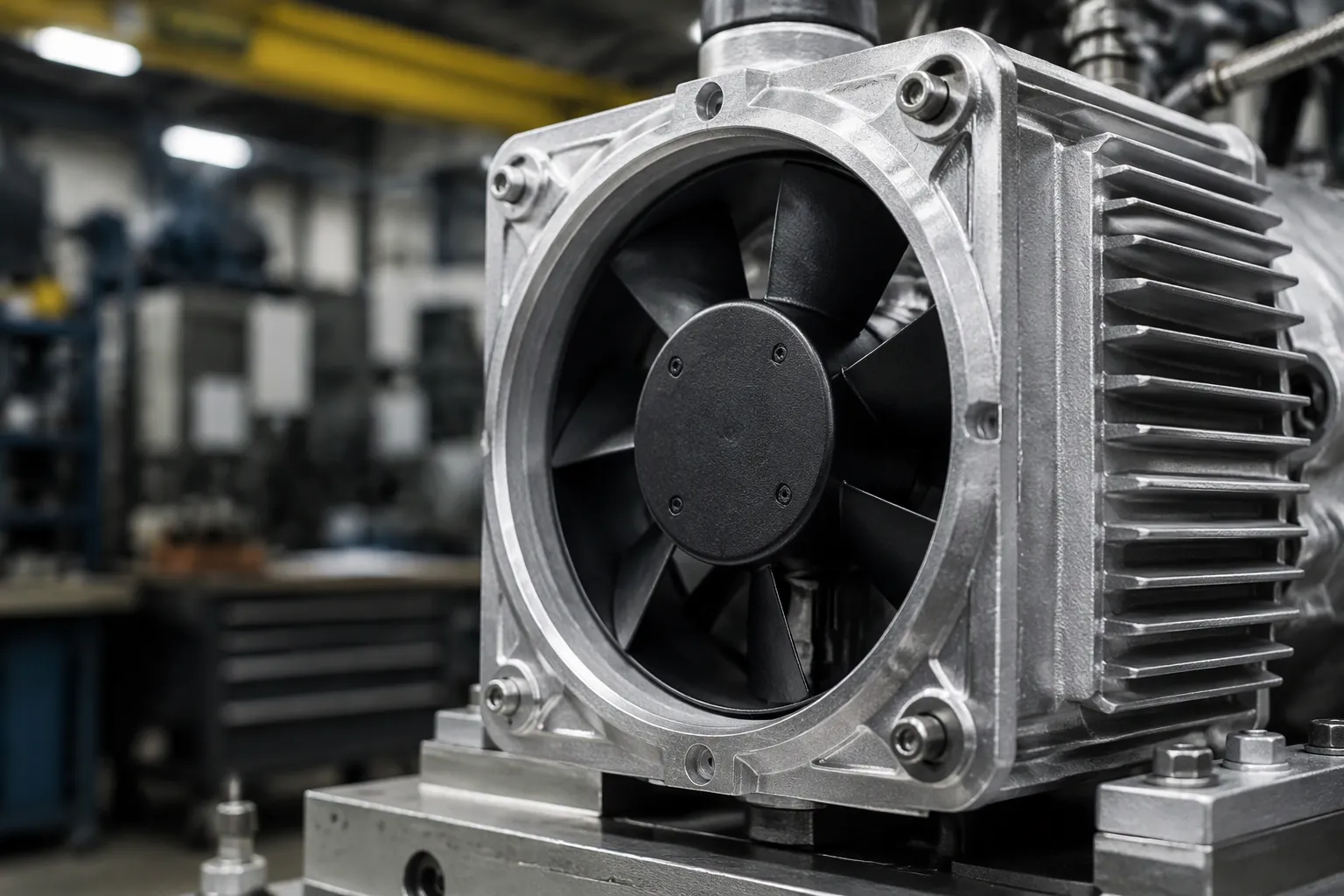
Industrial OEMs choose die-cast aluminum housings for AC axial fans because of five benefits: better heat control, strong structure, EMI shielding, design flexibility, and lower cost at scale. Engineering plastic and stamped steel are still good choices on their own. Plastic works well for light-duty, low-temperature enclosures, and stamped steel fits cost-sensitive, moderate-duty assemblies. Material choice depends on the application, not a single ranking. When heat, vibration, contamination, and EMC needs all come together, aluminum earns its place. This article looks at each benefit in technical detail. Engineers and procurement teams can then weigh the tradeoffs against real operating conditions and lifecycle costs.
Key Takeaways
Die-cast aluminum housings move heat away from the motor. This keeps the bearings and windings cooler, so they last longer.
Aluminum housings stay stiff when things shake. They also resist oil, chemicals, and aging. This keeps the fan lined up and working well in tough places.
A metal housing blocks electromagnetic interference without extra parts. This helps OEMs meet EMC rules and makes grounding simpler.
Die casting makes complex shapes in one piece, so OEMs get custom mounting and airflow features without extra assembly steps.
When you make a lot of fans, the upfront tooling cost gets spread out. The longer service life often makes aluminum the better total investment.
Thermal Performance of Die-Cast Aluminum Axial Fans
Heat Spreading Through the Housing
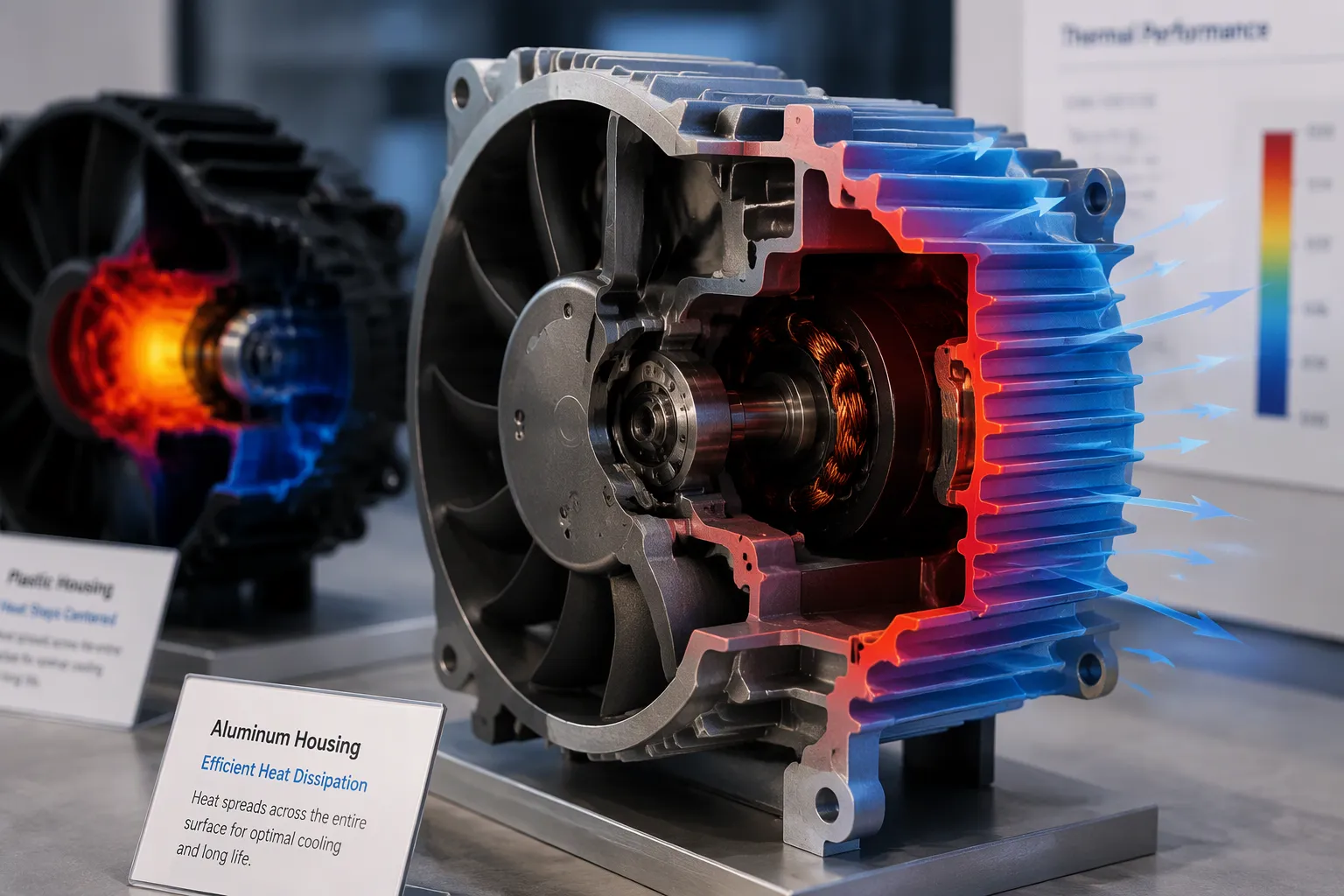
An axial fan motor turns electrical energy into rotation, and some of that energy comes out as heat. Bearings add friction losses on top of that. In a die-cast aluminum housing, the metal body works as a heat spreader. Heat moves from the motor windings and bearing seats into the casting around them. Then it spreads across the full housing surface. Air moving through the fan passes over that surface and carries the heat away. This path keeps the motor and bearings cooler during long runs. Cooler bearings keep their lubricant in good shape longer, and cooler windings age more slowly. Both effects help the fan last longer under continuous duty.
The shape of the casting matters here. Ribs, thick sections around bearing seats, and plenty of surface area all give heat more ways to leave the motor. A well-designed housing turns the whole outer shell into a cooling surface, not just the area near the motor.
Aluminum Versus Plastic Under Continuous Load
Engineering plastic acts very differently under steady thermal load. Plastic is a thermal insulator. Heat from the motor stays near its source instead of spreading through the housing. Over time, constant heat can soften the material and cause discoloration. The housing may lose stiffness right where the motor needs support. Aluminum conducts heat and gives it off, so the housing stays structurally stable while it cools the motor.
Plastic still has a clear place. Light-duty fans in low-temperature enclosures rarely build up much heat. In those applications, a molded plastic housing can meet the need at low weight and low cost. The choice follows the duty cycle and the ambient conditions.
Belmont's Axial Fans show housings built for continuous industrial duty. The range includes both AC and EC motor options, and most models carry IP54 protection, with selected heavy-duty models rated IP55. These ratings cover dust and water ingress, and the die-cast aluminum construction supports the thermal side of the same continuous-duty requirement. Engineers judging a fan for round-the-clock operation should treat housing material and protection rating as one decision, not two.
Structural Durability in Harsh Environments
Vibration and Impact Resistance
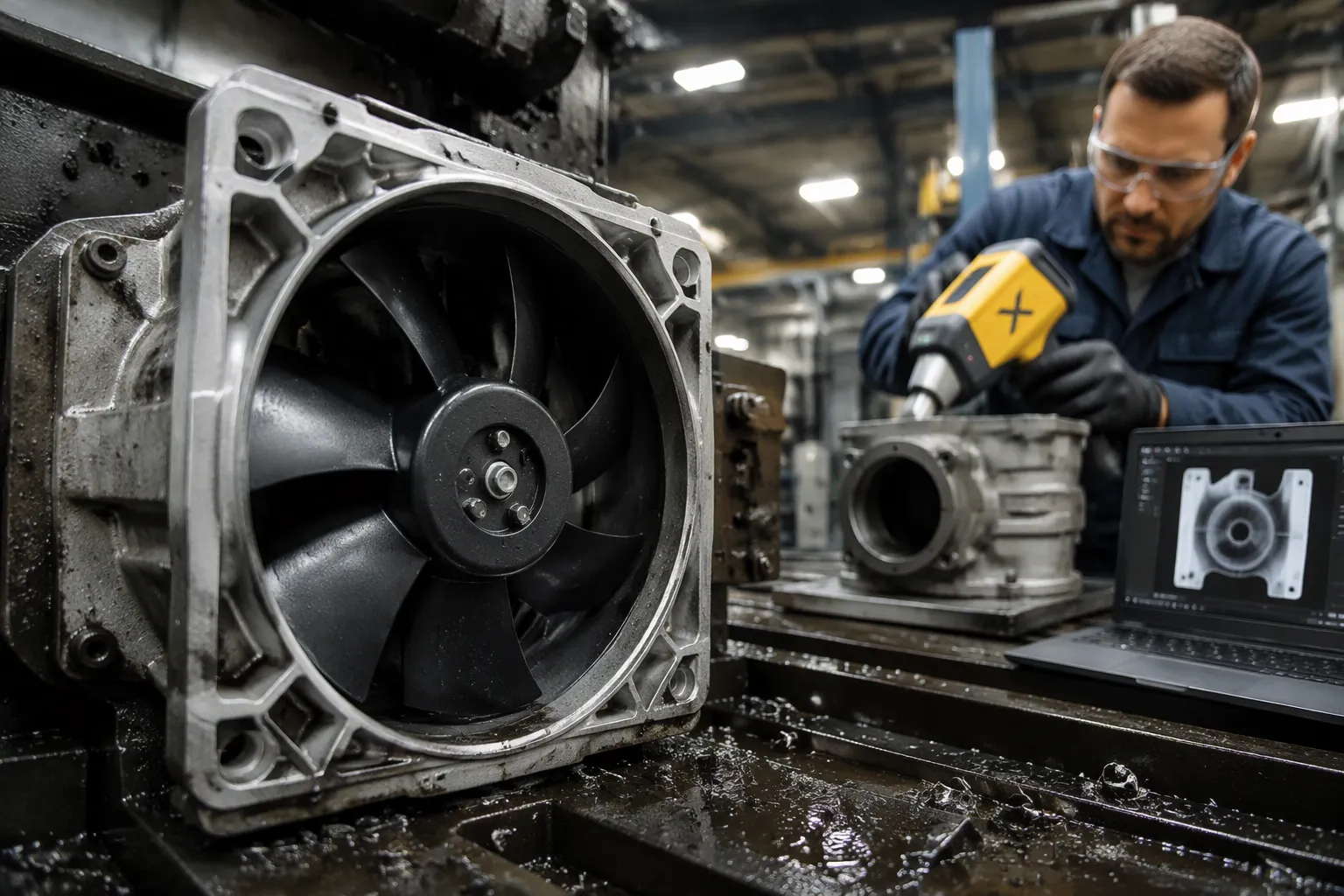
Die-cast aluminum has a strong strength-to-weight ratio. A fan housing made from it keeps its shape under vibration, shock, and accidental spills. Rigidity matters most in heavy machinery, laser cutting equipment, and rail or vehicle power cabinets. These setups expose the fan to constant shaking and sudden jolts. A housing that flexes can let the impeller rub against the frame. It can also loosen the motor mounts over time. A rigid aluminum casting keeps the impeller and motor lined up through years of rough service.
High-pressure die casting also allows X-ray inspection of finished parts. Inspectors can check internal walls for voids and porosity without cutting the part open. This step confirms that the casting has the density and integrity the design calls for. Compact dimensions do not force a tradeoff here. A thin, tightly packed housing can still deliver high rigidity because the casting process forms strong ribs and reinforced corners in one piece. OEMs gain space inside crowded cabinets without weakening the structure.
Stamped steel and molded plastic still serve many applications well. Stamped steel suits cost-sensitive, moderate-duty assemblies where weight is not critical. Molded plastic fits light-duty enclosures with low vibration and low thermal load. Each material has a natural fit, and the application conditions should guide the choice.
Resistance to Oil, Chemicals, and Aging
Industrial environments expose fan housings to oil mist, coolants, cleaning agents, and airborne contaminants. Die-cast aluminum resists these exposures well. The metal does not soak up oil or swell when it touches chemicals. Its surface stays dimensionally stable, so mounting holes and mating faces keep their fit. Aluminum also resists aging from heat and ultraviolet light. A metal housing does not turn brittle or chalky after years in service. That stability supports long maintenance intervals in heavy-duty installations.
Plastic housings can soak up certain solvents and may break down under long chemical contact. Stamped steel needs coating or plating to resist corrosion, and that coating can chip over time. Neither limitation rules these materials out. Plastic remains a practical choice for clean, low-exposure enclosures. Coated steel works well in dry, controlled settings. Engineers evaluating Axial Fans for contaminated or outdoor-adjacent locations should match the housing material to the actual exposure list. Die-cast aluminum gives the widest margin when oil, chemicals, and aging pressures combine. Belmont's Axial Fans pair this housing durability with IP54 protection on most models and IP55 on selected heavy-duty versions, giving OEMs a housing and ingress rating that work together in harsh settings.
EMI Shielding and Regulatory Compliance
Conductive Enclosure and EMC Performance
A die-cast aluminum housing makes a continuous conductive shell around the motor and wiring. This shell stops electromagnetic interference from going in or out. Motors, drives, and switching circuits make electrical noise. A metal enclosure takes in and reflects that noise before it reaches nearby cables or sensitive electronics. Plastic housings do not conduct. They let interference pass through unless the OEM adds conductive coatings, metal mesh, or inserts. Each of those additions means extra parts, extra process steps, and extra cost. The aluminum casting gives shielding as a built-in property of the housing itself.
Shielding quality also depends on the enclosure seams. Tight mating faces and metal-to-metal contact at the frame joints keep the shell electrically continuous. Die casting forms these faces in one piece, so the housing keeps its shielding performance across the full service life.
Grounding and Industrial Standards
The aluminum frame gives designers a direct grounding path. A grounding lug or screw bonds the housing to the cabinet earth. This bond drains stray currents and keeps the enclosure at a stable potential. Electrical cabinets and industrial automation equipment depend on this path for EMC compliance. A grounded metal housing also lowers the risk of interference coupling between adjacent drives and control boards. Plastic enclosures need separate grounding hardware, and that hardware can come loose over time.
Belmont states that its products and processes carry ISO 9001, CE, and UL certifications, with CE and RoHS compliance documentation available. OEM procurement teams can use these documents during supplier qualification and regulatory review. The certifications support the compliance side of material selection. Engineers should still confirm the exact documentation package for each model before final approval.
Design Flexibility and Integration
Complex Geometries From Die Casting
Die casting makes complex shapes in one single step. Mounting bosses, flanges, connector cutouts, and smooth shroud curves all come from one mold. The hot metal fills every part of the tool, so the finished piece arrives with its mounting points and airflow surfaces already formed. This ability removes extra machining steps. It also cuts assembly labor, since the housing no longer needs separate brackets or welded flanges. A designer can shape the shroud around the impeller for smoother airflow and place bosses right where the cabinet needs them. Each feature adds function without adding parts to the bill of materials.
Belmont Customization for OEM Integration
Belmont backs this design freedom with in-house mold development. The engineering team builds tooling on site, so a custom housing goes from drawing to sample without an outside vendor involved. OEM and ODM customers can specify mounting structure, voltage, airflow, and impeller material. The Axial Fan range runs from 200 mm to 910 mm in diameter, which gives designers room to match a housing to compact equipment or large industrial cabinets. Standard models usually ship in 7–15 working days, and custom work follows a set development path.
The Spanish HVAC manufacturer case shows the process in action. Belmont supplied customized mounting plates that matched the customer's existing chassis, plus preassembled airflow components that cut installation work. The customer's R&D manager praised the engineering support and on-time delivery. For OEMs, the lesson is simple: a die-cast housing can hold mounting, airflow, and connector features in one part, and a supplier with in-house tooling can turn those needs into production hardware.
Cost Considerations for Axial Fans at Scale
Tooling Investment and Unit Cost at Volume
Die-cast tooling costs a lot of money up front. That cost is in the mold, not in each part. As production volume grows, the tooling cost spreads over thousands of units, and the price per unit drops. Plastic molding works on a different curve. Its tooling is usually lighter, so it pays off at lower volumes. Each material fits a different production profile. Die-cast aluminum pays off on long runs and stable designs. Plastic suits shorter runs, frequent design changes, and lower-volume programs. Procurement teams should compare quotes at their real annual volume, not at a single sample quantity.
Total Cost of Ownership Over Service Life
Unit price tells only part of the story. A die-cast housing stands up to heat, vibration, and chemical exposure, so the fan stays in service longer. Thermal spreading keeps bearings and windings cooler, which stretches replacement intervals. The conductive shell delivers EMI compliance without added coatings, mesh, or inserts, so the bill of materials stays lean. Fewer failures mean fewer service calls and less downtime. In heavy-duty applications, these savings can offset a higher purchase price over the life of the equipment. Light-duty programs may still find plastic or stamped steel more economical across their shorter service window.
Belmont supports both ends of this spectrum. The company runs small-batch trials and large-scale production, and it sets OEM/ODM pricing around the customer's volume and customization level. Buyers evaluating Axial Fans can request quotes at trial and production quantities, then weigh unit cost against expected service life.
Die-cast aluminum housings give AC axial fans five clear advantages: heat spreading, structural rigidity, EMI shielding, design freedom, and favorable cost at volume. Where vibration, heat, contamination, and EMC demands converge, aluminum delivers a balanced solution. Plastic and steel keep their own niches in light-duty and cost-sensitive work.
OEMs should specify housing material from real operating conditions and lifecycle cost, not unit price alone. Belmont's Axial Fans range and engineering team offer a practical starting point for that evaluation.
FAQ
Why do OEMs choose die-cast aluminum over plastic for AC axial fan housings?
Aluminum spreads motor heat, stays rigid under vibration, and blocks EMI without extra parts. Plastic traps heat and needs coatings for shielding. Plastic still works for light-duty, low-temperature enclosures. The application conditions decide the material.
Do die-cast aluminum housings raise the fan's purchase price?
The mold holds most of the upfront cost, and that cost spreads across production volume. Unit price drops as yearly volume grows. Buyers should compare quotes at their real order quantity, then weigh price against service life and maintenance savings.
When does plastic or stamped steel remain the better choice?
Plastic suits light-duty fans in low-temperature, low-vibration enclosures. Stamped steel fits cost-sensitive, moderate-duty assemblies in dry, controlled settings. Both materials serve their applications well. Engineers should match the housing to the actual duty cycle and exposure list.
How can procurement teams check housing quality before approval?
High-pressure die casting allows X-ray inspection of internal walls for voids and porosity. Buyers can also ask for quality documentation. Belmont states ISO 9001, CE, and UL certifications, with CE and RoHS compliance documents ready for supplier qualification.
Which Belmont axial fan models suit continuous industrial duty?
Belmont's Axial Fan range runs from 200 mm to 910 mm in diameter, with AC and EC motor options. Most models carry IP54 protection, and selected heavy-duty models are rated IP55. Standard models usually ship in 7–15 working days.


