


What Is an EC Fan in an AHU: Definition, Working Principle and Full Form
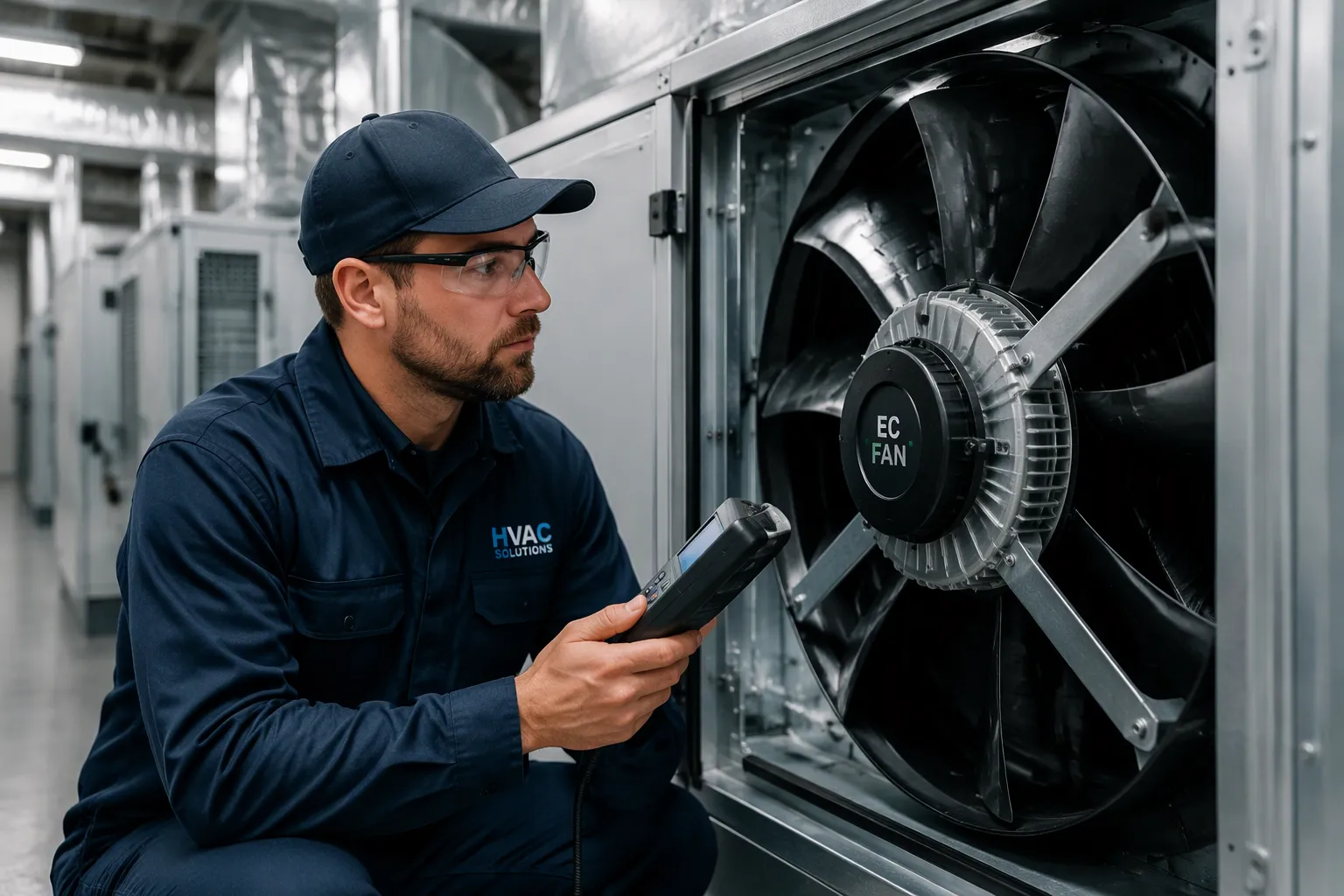
An EC fan is a fan run by an electronically commutated motor, so EC stands for Electronically Commutated. The motor takes an AC supply. It works much like a brushless DC motor with built-in electronics. That mix of AC input and DC-style control explains why these fans are getting more popular. EC fans now show up in more air handling units (AHUs) because they offer adjustable speed and efficient part-load operation. Facility teams and equipment buyers hear the term often, so understanding it clearly is worth it. This article explains the working principle, the fan's role in an AHU, and how it compares with AC fans.
Key Takeaways
EC stands for Electronically Commutated. An EC fan uses a special motor that saves energy and controls speed smoothly.
EC fans are more efficient than AC fans. They use up to 90% efficiency and can cut electricity use by 50%.
EC fans work well in air handling units (AHUs). They adjust airflow to match building needs, saving energy at part load.
EC fans are quiet and need less maintenance. They run at 28–35 dBA and have no brushes to wear out.
Belmont offers EC fans from 133 mm to 720 mm. They help you pick the right fan for your AHU and provide custom options.
EC Fan Definition and Full Form
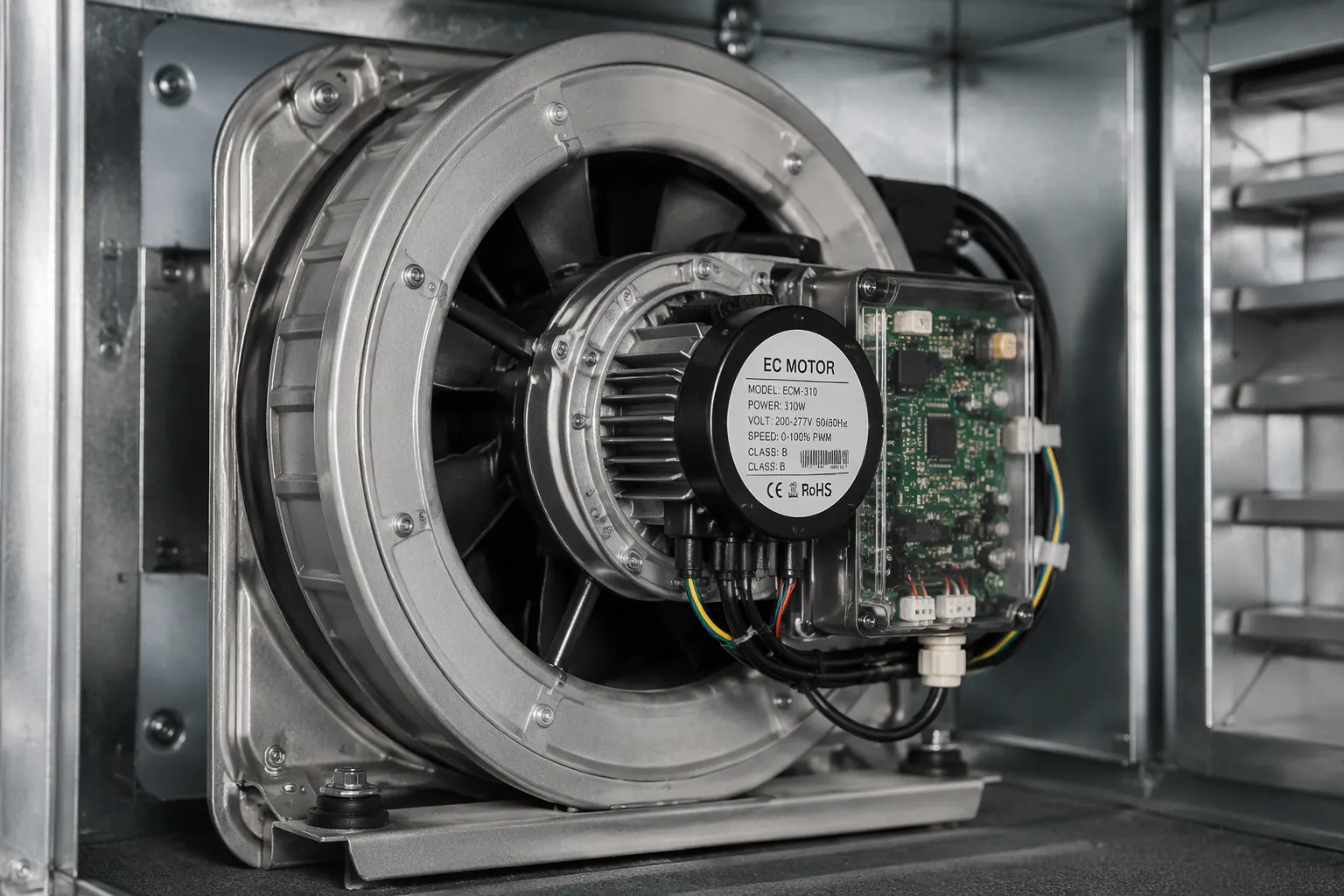
An EC fan is a device that moves air using an electronically commutated motor. This motor design mixes three things: an AC power input, electronic control parts, and the efficiency of a DC motor. The result is a fan that runs on normal AC electricity but works with the precision and energy savings of a DC drive. That mix is the main reason an EC fan is different from a regular fan.
What EC Stands For
EC is short for Electronically Commutated. The full form shows up in two common ways. Some people write "Electronically Commutated fan." Others use "electronically commutated fan" in lowercase inside a sentence. Both mean the same thing. The word "commutated" refers to how the motor switches current direction in its windings. In a traditional motor, this switching happens by machine through brushes and a commutator. In an EC motor, electronics do the switching instead. That is why the word "electronically" comes first.
The short form EC is used a lot in HVAC catalogs, technical datasheets, and building specs. You may also see it written as "ECM," which stands for electronically commutated motor. The fan itself is sometimes labeled an "EC fan" or an "EC plug fan" based on how it is mounted. These labels all point to the same core technology.
EC Fan vs. EC Motor
People often use "EC fan" and "EC motor" as if they mean the same thing. They do not. The motor is a single part. It turns electrical energy into rotational force. The fan is the complete air-moving assembly. It includes the motor, the impeller, the housing, the mounting bracket, and any built-in controls. You can buy an EC motor by itself. You cannot run it as a fan without adding an impeller and a frame.
This difference matters when you read product listings or talk with suppliers. A datasheet for an EC motor will list torque, speed, and voltage. A datasheet for an EC fan will list airflow, static pressure, and sound level. The fan datasheet also includes the motor's performance, but it adds the aerodynamic data that tells you how the fan will act in a real AHU.
It also helps to compare the EC motor with a traditional AC asynchronous motor. An AC asynchronous motor runs at a speed tied to the supply frequency. It cannot easily change speed without a separate variable frequency drive. An EC motor has built-in electronics that adjust speed smoothly and efficiently. That built-in control is why EC fans respond so well to changing airflow demands in an AHU. A later section will compare these two motor types in more detail.
For now, remember the key point: EC stands for Electronically Commutated. The motor is the engine. The fan is the whole vehicle. Belmont builds both the motor and the complete fan assembly, so the parts work together as one optimized unit.
How an EC Fan Works
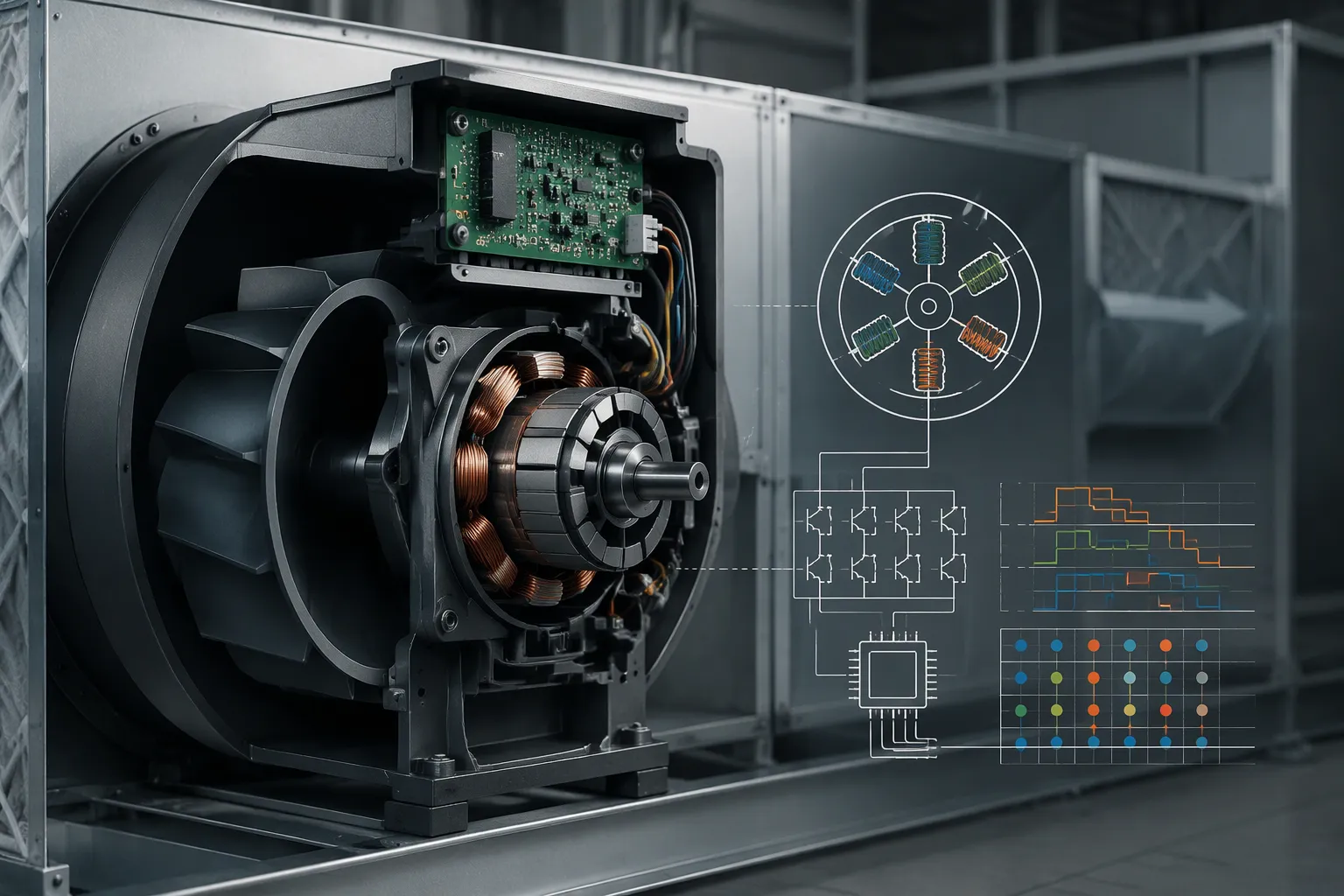
An EC motor is a brushless DC motor with permanent magnets and built-in electronics that control the rotor. This design gets rid of the brushes and mechanical commutator that older motor types use. Instead, a solid-state circuit does the switching. The result is a motor that runs cooler, lasts longer, and reacts faster to speed commands.
Brushless DC Motor and Commutation
A brushless DC motor uses permanent magnets on the rotor and stator windings that are controlled by electronics. The controller sends a timed sequence of currents to the stator. These currents make a rotating magnetic field. That field pulls the permanent magnets around, which spins the rotor.
Electronic commutation is the process of switching current between motor windings based on where the rotor is. A brushed DC motor uses mechanical brushes and a commutator to reverse current direction. A brushless motor does the same job with semiconductor switches. The controller has to know the rotor's position before it picks which windings to energize. Some designs use Hall-effect sensors to measure rotor position directly. Others measure back-EMF in the undriven coils to figure out position without separate sensors.
The commutation sequence follows a repeating pattern. In a three-phase motor, six steps complete one electrical revolution. Each step energizes one positive phase, one negative phase, and leaves one phase floating. The controller repeats this sequence as the rotor turns. Pulse width modulation controls the effective voltage and helps manage phase current. This lets the controller handle motor speed and torque when load conditions change.
Feature | Brushed DC Motor | Brushless DC Motor |
|---|---|---|
Commutation | Mechanical | Electronic |
Brushes | Required | Not required |
Maintenance | Generally higher | Generally lower |
Efficiency | Typically lower | Typically higher |
Service life | Limited partly by brush wear | No brush-related wear |
Rotor, Inverter, and Controls
The rotor in an EC motor uses permanent magnets instead of an induction design. The inverter switches the stator windings in sequence to pull the magnets around. There is no slip, no rotor current, and no belt. The impeller bolts directly to the rotor.
The inverter is a smart power module mounted with the rectifier in a sealed housing on the fan hub. This housing keeps dust and moisture away from the electronics. The conversion path starts with AC input. The rectifier changes AC to DC. Then the integrated inverter converts DC back to three-phase AC at variable frequency. This variable frequency gives precise speed control.
Speed is set by a signal, not by a mechanical pulley ratio. An ec fan accepts 0–10 VDC, PWM, or MODBUS signals. The drive knows its own electrical state. It can report DC-bus voltage, DC-bus current, inverter temperature, actual rpm, and fault flags over the same MODBUS link. This feedback helps with building automation and fault detection.
EC fans make less heat during operation than traditional AC motors. Less heat means less energy lost as waste. This helps with energy efficiency and makes motor parts last longer. The onboard electronics also stop brush and commutator erosion. That cuts down on maintenance needs and electromagnetic interference.
The EC Fan's Role in an AHU
An AHU fan must push air through filters, coils, dampers, and ductwork. Each of these parts adds resistance. High static pressure and stable airflow matter for the unit to do its job. A weak fan cannot overcome that resistance, and the building gets less treated air than it needs.
Supply and Return Air Movement
The supply fan pushes conditioned air into the ductwork and toward the rooms. The return fan pulls stale air back from the space, often through more filters and dampers. Both fans face changing resistance as filters load up and dampers move. EC speed control lets each fan adjust airflow to match filtration, temperature, and occupancy loads. The fan slows when demand drops and speeds up when the building fills.
Efficiency and Building Automation
The drive electronics sit inside the motor. The fan takes a 0–10 VDC or PWM signal straight from the building automation system and changes speed to match the load. No separate VFD is needed in the mechanical room. A MODBUS link adds stepless speed control and lets the system read fan status. Fan power falls much faster than fan speed, so every hour at reduced speed saves energy. This is a main reason AHUs prefer EC fans over fixed-speed designs.
Belmont supports this role with EC backward curved centrifugal and axial fans for AHU compartments. A modular one-piece design combines the inlet ring, grille, and mounting bracket. That compact build fits standard compartments and cuts assembly steps. For broader HVAC layouts, see Belmont's HVAC systems for buildings and commercial use.
EC Fans vs. Traditional AC Fans
Efficiency and Control Differences
An EC fan and an AC fan differ in how they turn electricity into airflow. EC fans use brushless DC motors with built-in rectifiers. This design can reach efficiency levels up to 90%. AC fans depend on traditional AC induction motors. Their efficiency usually falls between 50% and 75%. The gap gets bigger at part load. In many variable-load applications, EC fans can deliver up to 70% more efficiency and use 50% less electricity.
Control methods separate the two designs even more. An EC fan has built-in electronics for precise speed control. It takes 0–10 VDC, PWM, or MODBUS signals directly. An AC fan runs at a fixed speed or offers only a few set speeds. Precise speed control usually needs an external variable frequency drive. That adds cabinet hardware, wiring, and conversion losses. Noise levels follow the same pattern. EC fans run quietly at measured levels between 28 and 35 dBA. AC fans range from 40 to 50 dBA.
Characteristic | EC Fans | AC Fans |
|---|---|---|
Efficiency | Up to 90% | 50–75% |
Noise Level | 28–35 dBA | 40–50 dBA |
Speed Control | Integrated, hundreds of steps | Fixed or staged, external VFD for modulation |
Maintenance | Lower, brushless | Higher with belt-drive and external hardware |
Where Each Option Fits Best
EC fans work well for variable-load AHUs that run all the time and for systems tied into a BMS. A VAV system in a large office building can swap belt-driven AC fans for direct-drive EC units. Fan-system efficiency then goes up across the whole load range. EC fans also fit data center cooling and server rack applications. Installation is easy because an EC axial fan drops right into the existing unit housing.
AC fans are still a practical choice for simple fixed-speed jobs or budget-driven applications. Fixed-speed exhaust, basic airflow duty, and budget-first replacements often favor AC designs. The upfront cost is lower. For low-hour, simple-duty use, the total cost of ownership can be competitive. Belmont offers both EC and AC motor options in its Backward Curved Centrifugal Fans. You can pick based on the application instead of the other way around.
Selecting an EC Fan: Belmont Backward Curved Centrifugal Fans
Sizing, Controls, and Compatibility
Fan selection starts with the duty point. Add up the resistance from filters, coils, dampers, and ductwork. Then match that static pressure to the airflow you need. A fan that is too big for the job wastes energy and runs loudly. Belmont's Backward Curved Centrifugal Fans come in impeller sizes from 133 mm to 720 mm, with airflow up to 20,000 m³/h. You can choose EC or AC motor options, plus IP54 protection and single-phase or three-phase voltage choices.
Electrical and control compatibility come next. Check the supply voltage and frequency against your local grid. Then check the control signal your building system sends. The 400 mm EC model BEFEC102-B400-040 shows how these details line up in practice:
Parameter | BEFEC102-B400-040 |
|---|---|
Maximum airflow | 3927 m³/h |
Rated speed | 1670 RPM |
Power | 460 W |
Supply | 220/230 VAC |
Control | 0–10 VDC/PWM or MODBUS |
Ambient range | -20°C to +60°C |
A European AHU manufacturer put this approach to the test. The company swapped its existing EC centrifugal fans for a Belmont EC backward curved centrifugal fan. This fan delivers about 8,500–9,000 m³/h above 1,500 Pa. The swap cut energy use by 30% and now supports 2,000 units per year.
Support and Customization
Every AHU layout is different. That is why Belmont offers OEM and ODM customization for impeller design, voltage, mounting, housing, and cable length. In-house mold development and flexible production handle both small trial batches and large orders. ISO 9001, CE, and UL certifications back the quality process from raw material to delivery.
Selection help matters as much as the hardware. Belmont's engineering team advises on airflow, static pressure, and control signals. They then stay involved through installation and after-sales service. You can review the full Backward Curved Centrifugal Fan lineup or learn more about Belmont before choosing an ec fan for your next AHU project.
An EC fan moves air using an electronically commutated motor, and the full form is Electronically Commutated. Inside, AC power turns into DC, and then an inverter changes it back to variable three-phase AC for exact speed control. This design lets AHUs run efficiently at part load and match airflow smoothly for both supply and return jobs. In buildings with changing loads, an ec fan often beats fixed-speed AC options for energy and control. Belmont makes EC and AC backward curved centrifugal fans from 133 mm to 720 mm and helps with selection, customization, and after-sales service. Contact Belmont to match a fan to your AHU duty point.
FAQ
Is "EC fan" the same as "ECM fan"?
No. ECM stands for electronically commutated motor, and it is just one part inside the fan. An EC fan is the whole air-moving unit: motor, impeller, housing, and controls. Catalogs sometimes use the two labels loosely, so check whether the datasheet lists airflow and static pressure or only motor data.
How does an EC motor differ from an AC asynchronous motor?
An AC asynchronous motor runs at a speed tied to supply frequency and needs an external drive to vary that speed. An EC motor carries its own rectifier and inverter, so it changes speed smoothly from a 0–10 VDC, PWM, or MODBUS signal without extra cabinet hardware.
Why do AHUs favor EC fans over fixed-speed designs?
AHU fans must push air through filters, coils, dampers, and ductwork, and that resistance shifts constantly. EC speed control lets supply and return fans track those changes instead of running flat out. Fan power drops sharply as speed falls, so part-load hours bring real savings.
Can one EC fan serve both supply and return duty?
Yes. The same EC backward curved centrifugal model can run on either side of an AHU. Each fan gets its own control signal, so the supply fan and return fan adjust on their own as filters load and occupancy changes. Belmont's modular one-piece build fits standard compartments on both paths.
What should I confirm before ordering an EC fan from Belmont?
Match airflow and static pressure to your duty point first. Then confirm voltage, frequency, and control signal. Belmont's range covers 133 mm to 720 mm impellers and up to 20,000 m³/h, with EC or AC motors, IP54 protection, and OEM customization of impeller, mounting, and cable length.


