


EC Fans vs AC Fans in AHUs: Efficiency, Control and Total Cost of Ownership
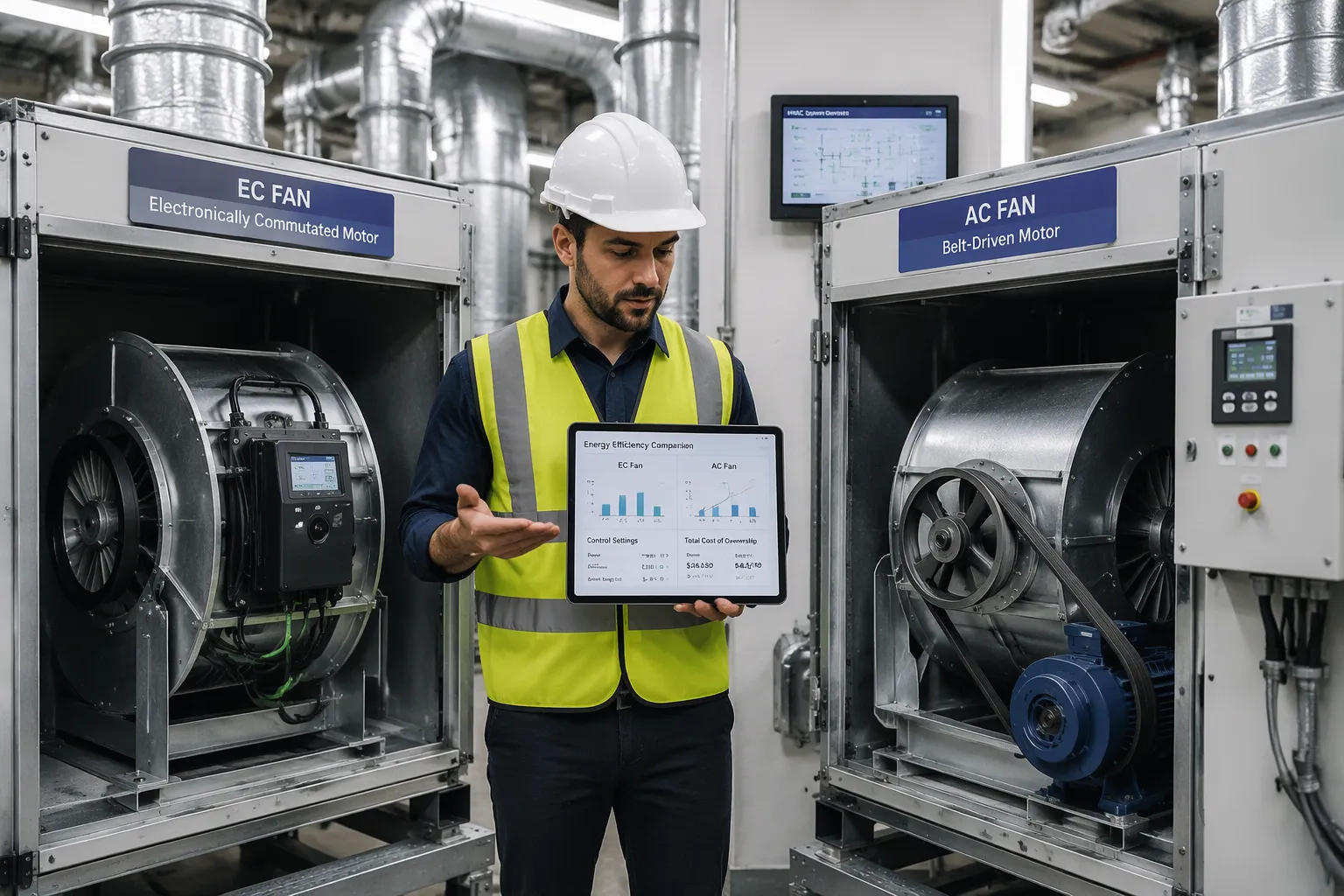
EC fans are usually the better choice for air handling units because they use less energy. Their built-in electronics also give you more precise speed control. Together, these two things often lead to a lower total cost of ownership, even though the upfront price is higher than an AC fan of the same size.
Three main points shape this comparison: efficiency, control, and total cost of ownership. Efficiency numbers show EC motors can reach up to 90%, while AC motors only reach 50–75%. Control sets apart built-in 0–10V, PWM, or Modbus regulation from belt-and-pulley or damper methods. Cost brings both of these together over the life of the equipment.
Engineers and facility managers looking at ec fans in ahu applications will find part-load performance, control methods, noise, maintenance, and a lifecycle cost example covered here. They will also get clear guidance on where each fan type works best.
Key Takeaways
EC fans use less energy than AC fans. This is especially true at partial load, where they can save up to 40% on energy costs.
EC fans have built-in speed control, so you can adjust airflow exactly without extra equipment.
EC fans often cost less over time because they save energy and need less upkeep.
EC fans run more quietly and more reliably. This makes them great for places where people work or rest.
AC fans still work well for simple jobs that run at one speed, where the upfront price matters most.
How EC and AC Fans Work
AC Fan Basics
An AC fan motor works by electromagnetic induction. Alternating current flows through the stator windings and makes a rotating magnetic field. That field causes a current in the rotor, and the push and pull creates torque that turns the shaft. The rotor falls a little behind the field, and this lag is called slip. The design needs no brushes, commutators, or built-in electronics, so the basic motor is strong and needs little upkeep.
Supply frequency and pole count set the speed. Synchronous speed in RPM equals 120 times the frequency divided by the number of poles. So a four-pole motor on a 50 Hz supply has a synchronous speed of 1,500 RPM. Under load it runs at about 1,420 to 1,470 RPM because of slip. With a fixed line frequency, the motor holds one design point, and efficiency drops outside that range.
EC Fan Basics
An EC motor has its own electronics inside the housing. A rectifier turns the AC supply into DC. Then a built-in controller sends the right current, in the right direction, at the right time, through each winding. Hall effect sensors track where each magnet is, so switching happens electronically instead of mechanically. This setup allows close monitoring and smooth variable-speed running.
The built-in controller also changes how the fan hooks up to a building system. Many packaged EC products take 0–10V, PWM, or Modbus signals directly. That means no separate drive sits between the controller and the motor. This all-in-one path sets up the efficiency and control comparisons in the sections that follow.
Energy Efficiency of EC Fans in AHUs
Full-Load vs Part-Load Performance
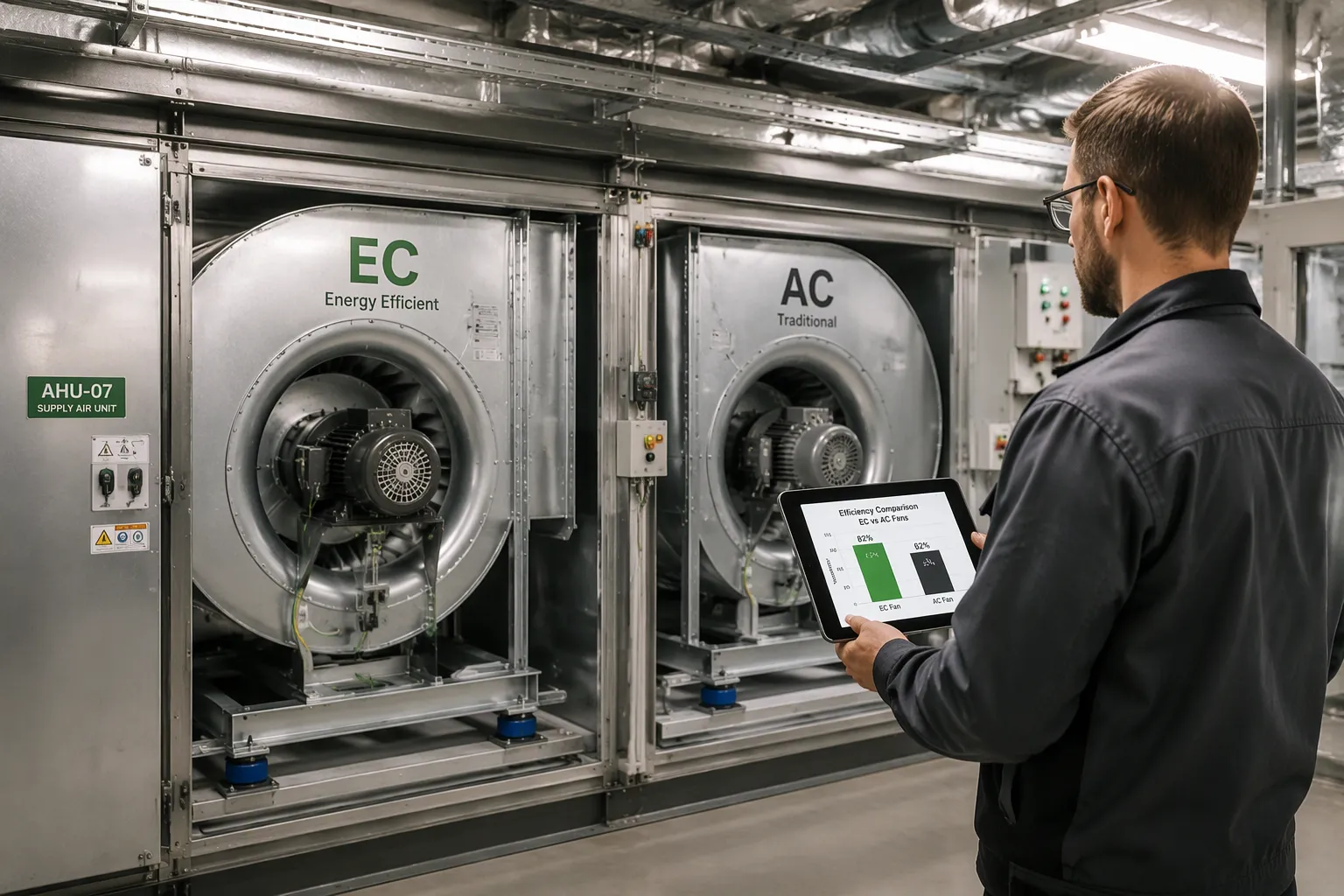
EC fans stay highly efficient across a wide airflow range, about 40% to 100% of rated flow. AC fans stay highly efficient only in a narrow range, about 70% to 100%. This gap matters because AHU fans seldom run at full capacity. Most systems run at 60–80% to keep pressure or temperature steady. AHUs often run many hours each day, so part-load efficiency drives yearly energy use. An AC motor's efficiency drops sharply at partial load. An EC motor stays highly efficient across a wide speed range.
The induction motor explains the gap. Slip lowers the basic efficiency ceiling, and the loss grows at part load. The AC efficiency curve is steep. Peak efficiency usually sits in the 75%–85% range of rated load and falls a lot outside that range. EC motors avoid this drop because built-in electronics adjust commutation as speed changes. Typical AC fans run at 50% to 75% efficiency. Typical EC fans run at 85% to 90%.
Direct motor coupling also removes belt slippage. Aerodynamic impeller design cuts turbulence losses. Both effects add to the electrical gain.
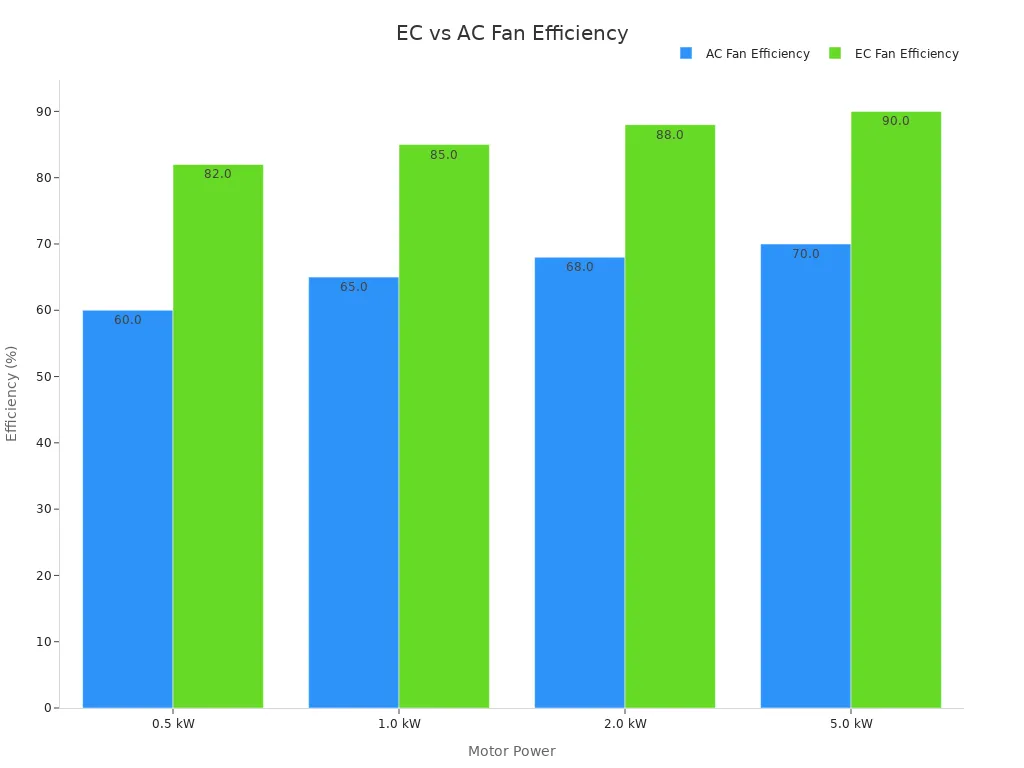
The table below compares typical motor efficiency at common power levels.
Motor Power | AC Fan Efficiency (Typical) | EC Fan Efficiency (Typical) |
|---|---|---|
0.5 kW | 60% | 82% |
1.0 kW | 65% | 85% |
2.0 kW | 68% | 88% |
5.0 kW | 70% | 90% |
The chart below shows the same comparison visually.
Real-World Savings Example
A European AHU manufacturer needed about 8,661 m³/h at 1,500 Pa. The company swapped its existing EC centrifugal fans for a Belmont EC backward curved centrifugal fan. Belmont custom-made the impeller size, airflow structure, soft-start behavior, and speed-control curve to fit the AHU. Reported results included a 30% cut in energy consumption, quieter operation, and fewer maintenance events across a yearly volume of 2,000 units. These figures are examples and reflect that specific installation. Shorter payback comes directly from lower kilowatt-hours at the same delivered airflow.
A smaller product example shows the same pattern. The Belmont 250mm EC radial plug fan delivers up to 3,800 m³/h while drawing 1,150W. Belmont reports up to 30% energy savings versus traditional AC fans. Integrated control supports 0–10V DC, PWM, or Modbus stepless speed adjustment.
For ec fans in ahu projects, the savings grow with operating hours. A fan that runs nonstop spends most of its life at part load, where the efficiency gap is widest. Filter loading and shifting occupancy push the duty point around, so the fan must stay efficient away from its design point. Specifiers comparing options for HVAC systems for buildings and commercial use should weigh this part-load behavior, not just the full-load rating. Operating hours and load profile decide the payback period more than the nameplate rating does. The same logic applies to any ec fans in ahu retrofit that replaces damped or throttled AC units.
Speed Control Compared
AC Control Methods
An AC fan runs at only one set speed. So engineers add extra equipment to change the airflow. Outlet dampers block airflow where it leaves the fan. Inlet vanes spin the air before it enters the fan. Variable frequency drives (VFDs) slow the motor down using electronics. These add-on methods use very different amounts of energy to deliver the same airflow.
Control Method | How It Works | Energy at 70% Flow | Efficiency |
|---|---|---|---|
Outlet damper | Blocks airflow at fan discharge | ~90% of full-load power | Very poor |
Inlet vanes | Spins air entering fan | ~80% of full-load power | Poor |
Variable pitch blades | Changes fan blade angle | ~65% of full-load power | Moderate |
VFD speed control | Slows motor speed | ~35% of full-load power | Excellent |
Dampers and vanes do not lower motor power. They turn extra energy into heat, noise, and vibration. A VFD-controlled fan at 70% airflow uses about 35% of full-load power, a 55 percentage point gap versus a damper-controlled unit. Fan power drops with the cube of speed, so slowing a fan by 20% cuts energy use by nearly 50%. ASHRAE 90.1 requires variable speed control for supply and return fans in AHUs over 5 hp.
EC Control Methods
EC fans in ahu installations have their drive electronics built into the motor housing. You do not need a separate VFD. The controller takes a low-voltage speed-demand signal directly. Three options are most common. A 0–10V analog signal works well for simple BMS speed control. PWM gives a digital pulse demand for OEM boards. Modbus RS485 adds two-way communication for monitoring, alarms, and multi-fan systems.
Analog control is one-way: the controller tells the fan how fast to run. Modbus becomes useful when the BMS needs status data back. Belmont's EC backward curved centrifugal fans support 0–10V and RS485 control, so airflow can match system demand precisely. The integrated approach removes belt-and-pulley wear and separate drive panels, which makes wiring and commissioning simpler.
Noise Performance
EC vs AC at Reduced Speeds
How quiet an AHU is often decides if it can go in a room with people. EC technology can cut noise by up to 12 dB more than AC fans at full speed, based on common industry findings. That gap comes from both the motor and the airflow path. An EC motor has no belt drive, so it gets rid of belt noise and pulley shaking. Its built-in electronics also keep a steady commutation pattern, which smooths out torque ripple. The result is a cleaner sound at the same delivered airflow.
Running at part load makes the advantage even bigger. Most AHUs spend their lives well below design flow, and fan sound power drops as speed falls. An EC fan slows down smoothly through its 0–10V, PWM, or Modbus signal. An AC fan on a damper still runs at full speed while the damper chokes the flow, so the motor and impeller keep making noise. A VFD-equipped AC fan can slow down too, but the separate drive and belt path add their own sound. For ec fans in ahu installations near offices, classrooms, or patient rooms, this difference shows up right in occupant comfort.
Lower part-load speeds also cut vibration. Slower rotor speed means lower dynamic imbalance forces and less structure-borne transmission into the AHU casing and ductwork. Belmont builds its backward curved centrifugal fans with balanced impellers and low-vibration construction, which helps quieter operation in sound-sensitive spaces such as data centers, laboratories, and cleanrooms. Specifiers should check sound power data at the actual duty point, not just at full speed, because the part-load figure is the one occupants hear.
Maintenance and Reliability
Service Life Considerations
EC fans usually need fewer service visits and are more reliable when loads change often. The reason is simple mechanics. An EC motor connects straight to the impeller, so there is no belt to stretch, no pulley to line up, and no separate drive panel to wire and check. Fewer moving parts mean less wear over time. In an AHU that changes speed many times a day, this lower mechanical wear leads to longer service intervals and less unexpected downtime. Downtime has its own cost: lost cooling or heating, emergency labor, and schedules thrown off. Facility managers should count these costs along with energy savings when they compare fan options.
Practical design details support reliability. Belmont backward curved centrifugal fans use ball bearings that need no maintenance, which removes the greasing routines that belt-driven AC setups often need. The fans also have IP54 protection, so dust and splashing water have limited access to the motor and electronics. That rating fits the damp, filter-loaded space inside a typical AHU. Sealed bearings and protected electronics together lower the chance of early failure between scheduled inspections.
The tone here should stay balanced. AC fans are still dependable workhorses in simple constant-speed duty. A fixed-speed induction motor with a belt drive has served AHUs for decades, and many sites run them with few problems. The reliability edge for EC fans shows up mainly where loads vary. Frequent speed changes, long run hours, and part-load running put more stress on belts, pulleys, and bearings in an AC setup. In those conditions, the direct-coupled EC design proves its worth. For ec fans in ahu installations that run nonstop, sealed bearings, IP54 protection, and no belt wear together support a longer, calmer service life.
Cost Analysis and Total Cost of Ownership

Purchase and Installation
An EC fan costs more to buy than an AC fan of the same size. The built-in electronics cause the gap: the rectifier, controller, and sensors all sit inside the motor housing. That higher price is real, and specifiers should plan for it upfront.
Installation often makes the gap smaller. An AC fan needs a separate variable frequency drive to change speed, plus the wiring, panel space, and setup labor that come with it. An EC fan takes its speed signal directly, so the drive panel is no longer part of the design. Fewer parts mean less wiring and a faster startup. Belmont's backward curved centrifugal fans come with both EC and AC motor options, so a project team can compare the two paths on the same mechanical platform.
Operating Costs and ROI
Total cost of ownership adds four items over the service life: purchase price, installation cost, energy cost, and maintenance cost. Energy usually dominates. A fan that runs all the time spends most of its hours at part load, where the EC efficiency advantage is widest. Maintenance adds a second stream of savings, because direct-coupled EC fans have no belts or pulleys to replace and fewer service visits to schedule. Downtime has its own cost in lost cooling or heating and emergency labor.
The R.C. case shows how these items combine. That European AHU manufacturer needed about 8,661 m³/h at 1,500 Pa and ran 2,000 units a year. After switching to a Belmont EC backward curved centrifugal fan, the company reported a 30% cut in energy consumption, lower procurement costs, and fewer maintenance events. These figures are examples and reflect that specific installation.
A simple payback example makes the math concrete. The assumptions below are examples, not a quote for any project.
Metric | Value |
|---|---|
Typical savings | 20–35% of fan energy consumption |
Current cost (15kW example) | £13,500/year |
EC fan replacement cost | £12,000–18,000 |
Predicted savings | 25% = £3,375 annually |
Simple payback | 3.5–5.5 years |
Payback depends heavily on operating hours. A fan running around the clock earns back its extra cost far faster than one running a single shift. For ec fans in ahu retrofits, the yearly hour count matters more than the nameplate rating. Belmont's EC backward curved centrifugal fans support 0–10V and RS485 control, so the airflow can follow real demand and protect the savings the payback math assumes.
When to Choose EC vs AC
Best Fits for EC Fans in AHUs
EC fans work best in air handling units where the load changes. Fan power drops by about the cube of speed, so smooth speed control helps most when AHUs run at partial load. EC fans usually save up to 40% at partial load compared with AC fans. A unit that changes speed with CO₂, occupancy, or a schedule needs a fan that slows down without wasting energy.
Smart-building connections make EC fans even stronger. Built-in electronics support 0–10V, PWM, and Modbus RTU (RS-485) connections. The Modbus return channel sends speed, current, and status back to the building automation system, which makes demand-controlled ventilation practical. Running all the time also favors EC fans in ahu designs, because direct-drive construction removes belt, pulley, and tensioner upkeep. Quiet spaces benefit too, since lower part-load speeds cut both airflow and mechanical noise. Hospitals, hotels, schools, and labs all fit this profile.
Best Fits for AC Fans
AC fans still make sense for simple constant-speed duty. A basic ventilation unit that runs at one fixed airflow does not need stepless control, so the lower purchase price helps the project budget. Budget-sensitive jobs with predictable loads also fit AC motors well. Sites that already run VFDs on their supply and return fans can keep that setup and avoid buying duplicate control hardware.
Basic ventilation tasks, such as parking garages or storage rooms, rarely justify premium motor electronics. Axial fans often serve these high-volume, low-pressure duties. AC motors stay dependable in these roles, and many facilities run them for decades with routine service.
Belmont's backward curved centrifugal fans come with both EC and AC motor options on the same mechanical platform. That range fits AHU applications that need high static pressure and flexible integration, so specifiers can match the motor to the duty instead of the other way around.
Selection Factor | Choose EC | Choose AC |
|---|---|---|
Load profile | Variable, part-load heavy | Constant speed |
Runtime | Continuous | Intermittent |
Controls | BMS integration needed | Standalone operation |
Budget | Lifecycle cost focus | Upfront cost focus |
Noise | Sensitive spaces | Non-critical areas |
EC fans win on efficiency, control, and total cost of ownership in most AHU applications where the load changes. Their part-load performance, built-in 0–10V, PWM, or Modbus speed control, and lower downtime costs are worth more than the higher purchase price. AC fans are still a smart choice for simple, constant-speed jobs with tight budgets.
Specifiers and facility managers can use this checklist:
Figure out yearly run hours and the load profile first, because payback depends on them.
Check which control interface the building automation system needs.
Compare lifecycle cost, not just the purchase price.
Match the motor type to the job; Belmont offers EC and AC options on one platform.
The best fan is the one that fits the application.
FAQ
Do EC fans really use less energy than AC fans in an AHU?
Yes, mostly when they run at part load. EC motors stay efficient across a wide speed range, but AC motors lose efficiency when you throttle or damp them. Belmont's R.C. case reported a 30% energy drop after switching to an EC fan. Real savings depend on your load profile and run hours.
Can an EC fan connect directly to a building management system?
Yes. EC fans take low-voltage control signals on their own, so you don't need a separate VFD. Belmont's EC backward curved centrifugal fans work with 0–10V and RS485 control. The Modbus channel also sends back speed and status data, which makes demand-controlled ventilation easy to set up.
Are EC fans quieter than AC fans?
In general, yes. Industry findings show EC technology can cut noise by up to 12 dB more than AC fans at full speed. Running at part load makes the gap even wider, because EC fans slow down smoothly while damped AC fans keep running at full speed.
What maintenance do EC fans need compared with AC fans?
EC fans need fewer service visits when the load changes often. Direct coupling gets rid of belts, pulleys, and tensioners. Belmont's backward curved centrifugal fans use ball bearings that need no maintenance and IP54 protection. AC fans stay dependable in simple constant-speed duty with routine service.
When does an AC fan still make sense for an AHU?
AC fans fit constant-speed duty, tight budgets, and sites that already run VFDs. Basic ventilation tasks rarely justify premium motor electronics. Belmont offers EC and AC motor options on the same backward curved centrifugal fan platform, so specifiers can match the motor to the job.


