


How do radial blade fans improve airflow efficiency?
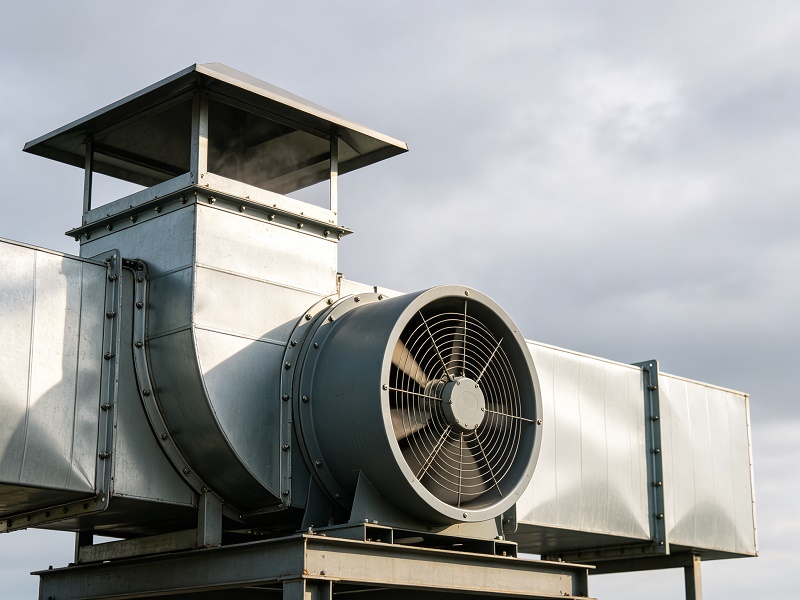
Poor airflow doesn't just cause discomfort — it drives up energy bills, shortens equipment life, and can disrupt critical operations. For engineers and facility managers specifying ventilation for air handling units, clean rooms, or industrial systems, the fan type and blade design determine whether a system performs or underperforms for its entire service life.
Radial fans have become the industry benchmark for high-pressure ventilation precisely because of how their blade geometry converts rotation into stable, efficient airflow. This guide explains the aerodynamics, compares the blade types, and gives you a clear framework for choosing the right radial fan for your application.
Key Takeaways
Radial fans use centrifugal force to build high static pressure — ideal for ducted and high-resistance systems.
Blade geometry (straight, backward-curved, forward-curved) directly controls efficiency, noise, and pressure output.
Backward-curved radial blade fans deliver the highest aerodynamic efficiency and are standard for HVAC air handling units.
Radial fans consistently outperform axial fans wherever airflow must overcome ductwork, filter, or coil resistance.
EC motor-equipped radial fans reduce energy consumption by 30–50% versus conventional AC motor designs.
Correct blade selection reduces noise, extends motor life, and lowers total cost of ownership.
What Are Radial Blade Fans?
A radial fan — also called a centrifugal fan — draws air in axially (parallel to the shaft) and discharges it radially (perpendicular to the shaft) at high pressure. The rotating impeller, made up of shaped blades, is what drives this process: as the impeller spins, centrifugal force accelerates air outward from the hub to the blade tips, converting rotational energy into static pressure.
This is the fundamental advantage of radial fans over axial fans. Axial fans move high air volumes along the shaft axis but lose output rapidly when system resistance builds — filters, coils, and long duct runs are all obstacles. Radial blade fans are engineered to push through that resistance and maintain stable, controlled airflow at the system's design point.
The blades define everything. Their angle, curvature, and count determine where a radial fan sits on the trade-off between volume, static pressure, efficiency, and noise — and that is where engineering precision matters most.
How Radial Blade Design Improves Airflow Efficiency
Centrifugal Force at Work
As a radial fan's impeller rotates, blades push air from the center outward. The air gains kinetic energy crossing the blade surface, and that energy converts into static pressure at the impeller exit. The result: a fan that drives air reliably through complex, high-resistance systems where axial fans would stall.
The Three Design Variables That Control Efficiency
Blade angle — The angle at which blades meet incoming airflow governs energy transfer efficiency. An optimized angle minimizes internal recirculation and turbulence losses inside the impeller.
Blade curvature — A curved profile guides air more smoothly than a flat surface, reducing boundary-layer separation and tip-vortex losses. Smooth flow across the blade means less wasted power.
Number of blades — More blades produce smoother, lower-pulsation airflow. However, over-crowded blade spacing creates a throttling effect that restricts volume flow. The optimum blade count balances pressure smoothness with unrestricted throughput.
Blade Types and Their Efficiency Profiles
Radial fans come in three main blade geometries. Each delivers a distinct performance trade-off:
Straight (Radial) Blades extend flat from the hub. They are the most rugged option — resistant to dust, chips, and abrasive particulates. The trade-off is lower aerodynamic efficiency due to greater internal turbulence.
Backward-Curved Blades angle away from the direction of rotation. This is the most aerodynamically efficient radial blade design, achieving total efficiency ratings of 75–85%. The power curve is also non-overloading: as system resistance rises, motor power draw stabilizes rather than climbing — protecting the motor and simplifying system design.
Forward-Curved Blades angle toward the direction of rotation, generating high airflow volume at lower static pressure. Suited to low-resistance residential and commercial HVAC applications, but less efficient under high static pressure loads.
| Blade Type | Static Pressure | Efficiency | Noise | Best Application |
|---|---|---|---|---|
| Straight (Radial) | High | Moderate | Higher | Dust/fume extraction, industrial ventilation |
| Backward-Curved | High | Excellent (75–85%) | Low | HVAC, AHUs, clean rooms, data centers |
| Forward-Curved | Medium | Good | Medium | Residential HVAC, commercial ventilation |
Five Key Efficiency Advantages of Radial Fans
1. Stable Output Under System Resistance. Radial fans maintain consistent, predictable performance across a wide range of static pressure conditions. This stability keeps the system operating near its design point, avoiding the energy waste and noise that come with off-curve operation.
2. High Total Efficiency. Backward-curved radial blade fans achieve 75–85% total efficiency at their design operating point. Paired with an EC (electronically commutated) motor — which adjusts speed to match actual demand — energy savings of 30–50% over fixed-speed AC designs are routinely achievable.
3. Non-Overloading Power Curve. As filters load up and system resistance increases, backward-curved radial fans stabilize motor power draw rather than allowing it to spike. This self-limiting characteristic protects the motor from thermal overload and extends service life without requiring oversized motor specifications.
4. Low Noise Operation. Smooth blade geometry significantly reduces turbulence-induced noise. Backward-curved radial fans operate much quieter than straight-blade alternatives at equivalent airflow — a critical advantage in hospitals, offices, laboratories, and clean rooms.
5. Compact Plug-Fan Architecture. Modern radial plug fans install directly inside AHU cabinets without an external scroll housing, reducing footprint and eliminating the aerodynamic losses of the scroll-to-duct transition. The result is a more efficient, quieter, and more space-efficient ventilation system.
Common Applications Where Radial Fans Excel
Air Handling Units (AHUs): Radial plug fans are the standard for AHU fan sections, pushing conditioned air through coils, filters, and distribution ductwork at measurable static pressure.
Clean Rooms: Backward-curved radial fans deliver precise, low-turbulence airflow for semiconductor, pharmaceutical, and medical device manufacturing environments.
Data Centers: High heat loads and spatial constraints make radial fans the default choice for server cooling and computer room air handlers.
Industrial Ventilation: Straight-blade radial fans handle exhaust streams laden with dust, fumes, and abrasive particles without clogging or blade degradation.
Commercial HVAC: Radial fans maintain consistent air distribution across multi-floor office buildings and retail centers with complex duct networks.
How to Choose the Right Radial Fan
Selecting the correct fan starts with four parameters:
Airflow (m³/h or CFM): Total air volume needed per hour, based on space size, occupancy, and heat loads.
Static Pressure (Pa or inches WG): Total system resistance — ductwork friction, filter drop, coil loss, and terminal losses combined.
Air Stream: Clean air calls for backward-curved blades. Particulate-laden or corrosive streams call for straight-blade radial fans with appropriate materials.
Motor Type: EC motors for variable-demand systems (most modern HVAC); AC motors for fixed-speed duty; DC motors for battery or low-voltage infrastructure.
With these parameters defined, fan performance curves let you confirm the operating point falls within the fan's peak efficiency zone — the critical step that separates a well-specified radial fan from an energy-wasting one.
Belmont Radial Plug Fans: Engineering You Can Rely On
With over 20 years specializing in fan engineering, Belmont manufactures a comprehensive range of radial plug fans in AC, DC, and EC configurations — covering impeller diameters from 225 mm to 560 mm — for air handling units, clean rooms, commercial HVAC, and industrial ventilation globally.
Belmont's EC radial plug fans combine backward-curved aerodynamic impellers with electronically commutated motors, delivering peak airflow efficiency with built-in variable speed control. All products carry TÜV certification to the low voltage directive 2014/35/EU. Verified service life exceeds 50,000 operating hours, with full OEM customization and technical support from a team of 20 dedicated engineers.
Frequently Asked Questions About Radial Fans
Q1: What is the difference between radial fans and axial fans?
Radial fans discharge air perpendicular to the shaft, building high static pressure ideal for ducted and high-resistance systems. Axial fans discharge air parallel to the shaft — better for high-volume, low-resistance applications like open-air cooling.
Q2: Are radial blade fans energy efficient?
Yes. Backward-curved radial blade fans with EC motors achieve system efficiencies of 75–85% and can reduce energy consumption by up to 50% over conventional AC-driven fans in variable-demand systems.
Q3: Which blade type is best for HVAC air handling units?
Backward-curved blades are the industry standard for AHUs — highest efficiency, lowest noise, and a non-overloading power curve that protects the motor under changing system conditions.
Q4: Can radial fans handle dusty or dirty air?
Straight-blade radial fans are designed for this. Their open geometry resists clogging and is easy to clean. Backward-curved blades are not recommended for dirty air without upstream pre-filtration.
Q5: What is a radial plug fan?
A radial plug fan is a radial fan without an external scroll housing. The impeller mounts directly inside the AHU cabinet — saving space, eliminating scroll-to-duct losses, and simplifying installation.
Q6: How long do radial fans last?
Quality radial fans operate reliably for 50,000+ hours with proper maintenance. EC motor versions often last longer due to reduced thermal stress from variable-speed operation.
Q7: What sizes do radial plug fans come in?
Radial plug fans are available from approximately 150 mm to over 600 mm impeller diameter, covering compact AHU applications to large commercial HVAC systems. Custom sizes are available for OEM projects.
Ready to Specify the Right Radial Fan?
The right blade geometry — matched to your operating conditions and motor technology — delivers lower energy costs, quieter operation, and longer equipment life from day one. Trust the team that has been engineering radial fans for over 20 years.
Explore Belmont's full radial plug fan range or contact our engineers directly for technical support, performance data, and OEM pricing.
Explore Belmont Radial Plug Fans →

